2014 International Student Conference on the Environment and Sustainability

Over the past week I had the opportunity to attend the International Student Conference on the Environment and Sustainability at Tongji University in Shanghai. Organized by UNEP and Tongji’s Institute of Environment for Sustainable Development, the goal of the conference was to provide an international platform to connect passionate students, researchers, policymakers and industry leaders from around the world who are actively engaged in finding solutions to the environmental and social challenges that threaten global sustainability.
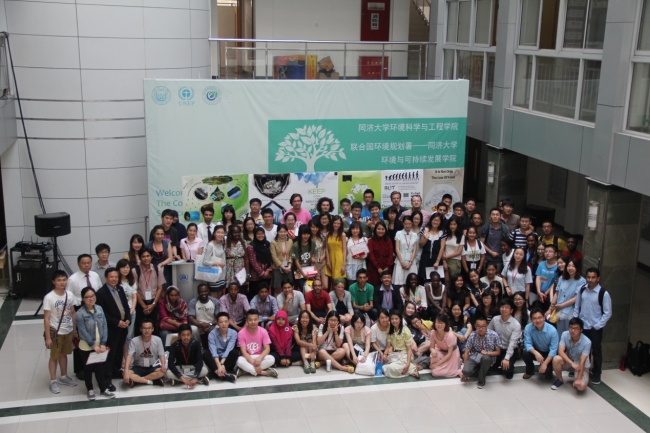
Tongji - Final Picture

Out of thousands of applicants, around 400 students from 47 countries were brought together under the theme of “Ecological Civilization and Green Development”. The first two days we attended a variety of panels and discussions held by speakers that ranged from international leaders to community-based practitioners, as well as students who have contributed outstanding research on energy transition and climate change.

These included the head of UNEP’s Green Economy research team, Dr. Sheng Fulai, who discussed the major policy issues and UNEP’s role in confronting the transition towards a sustainable pattern of energy consumption, namely: price and powerful subsidies, political commitment and the leadership role to be played by governments through public financing and simultaneous implementation of rules, regulations, and standards to facilitate the energy transition. Here’s perhaps the most notable quote:

“There is also a need for…reforming harmful policies such as perverse subsidies. As we know the world spends huge amounts of money supporting the use of fossil fuels and if we are able to reform and reduce fossil fuel subsidies and use the money to instead support the transition to renewable energy we will live in a much better world.”

We also heard from Tongji University Professor Zhang Xu, who introduced the results of a recent study on ‘Improving the Rural Energy Efficiency in China based on Evolution by Game Theory’. To summarize, in rural areas throughout China farmers often burned straw biomass directly in their fields, which not only added to pollution and caused a lot smoke and a strong smell, but was also a waste because it could be used as an energy source if it could be delivered to local power plants. Rather than forcing the farmers not to burn the straw, or asking them to deliver their straw to the power plants for compensation (which would have been too inconvenient for too little compensation), he used game theory to develop a ‘middle man’ principle – a middle man could collect the straw from many different families to deliver to the power plant, and he generated a compensation model that would equally balance the supply and demand between the various actors.

We also heard from green tech innovators like Florian Bohnert, who helped start My CO2, an international company that develops tech solutions for measuring and communicating environmental information, like ‘smart metering’ and visualizations of consumption data, to promote and enable end-user energy efficiency.

The final two days students joined one of four subgroups: Sustainable Education, Food and Health, Ecosystem and Climate Change, and Green Development based on our current research projects and interests, and shared how we are fighting in our local communities, as well as at the national and international levels, for the shift to sustainable, socially just environmental practices, policies, and technologies. Some of the outstanding student projects included Kennedy Liti Mbeva’s research on affordable and renewable energy supplies like locally-assembled solar panels and interventions like Clean Energy Cookstoves in rural Kenya, and Sarabeth Brockley’s research on the fracturing of rural communities as a result of hydrofracking activity and the growing presence of natural gas companies in the northeastern US. The final day each group presented a summary of the challenges and opportunities discussed with strategies and recommendations on how best to continue forward.

Within the context of the US and China’s back-to-back commitments to reduce CO2 emissions of power plants (the US to cut power plant carbon emissions 30% by 2030, and China to set a cap in the next 2016 5-year plan), it was inspiring to meet so many of the people who are engaged on the ground, pushing for these types of breakthroughs in climate negotiations and developing the technologies that are making the transition to renewables a reality.

At the same time, there was an overwhelming sense of urgency that time is running out. From the unstoppable collapse of the West Antarctic Ice Sheet  to worsening heat waves, droughts, wildfires, torrential rains and other extreme weather events, it is clear that catastrophic climate changes are already occurring and individual changes in behavior and consumption habits, while necessary, are no longer enough to keep us below the tipping points because the real culprits – the fossil fuel companies – have five times as much carbon in their reserves as it would take to destroy the planet, and as the richest and most powerful industries on Earth they intend to burn it unless we pressure our governments to step in, stop subsidizing them, and start leading us in this transition. Collective action at the local level is critical to set the world on a fundamentally new course.

On September 20th and 21st UN Secretary-General Ban Ki-moon has invited world leaders to convene in New York for a Climate Summit to catalyze action by governments, business, finance, industry, and civil society on climate change prior to the UNFCCC goal to reach a global climate agreement in 2015. This will be a pivotal moment to demand decisive action because the 2015 Paris talks are our last chance to come to an internationally binding agreement that could keep global warming below 2 degrees celsius and avoid an irreversible path of climate disaster. Climate change is the biggest crisis our civilization has ever faced, and I encourage you to join the September 21st Global Day of Action.
 

Posted in Conferences | Tagged , , | Leave a comment

Suichang Part II: Chinese New Year 2014

As I am sure you can imagine, I was ecstatic to get back in touch with the family from Suichang that I stayed with in 2010 (see previous post), and jumped at the opportunity when they invited me to spend ten days with them over the Spring Festival holiday.


While I was curious about how the tea farm was running as well as their restaurant, tea harvest season doesn’t start until March, and because it was winter break I assumed the restaurant would also be closed. Instead, I was simply looking forward to catching up, and was excited to participate in their New Year celebrations.

As I stepped off the bus I immediately heard Aiqiu, the mother, call my Chinese name, and we both erupted in laughter as we hugged. She led me over to where her husband sat in the driver’s seat of a shiny new car, and she explained they had replaced their old pickup truck earlier that year. We chatted nonstop on the ride back to their home- covering everything from her mother and father-in-law: who are fine and she said were also excited to see me; her daughters, who are now 14 and 9; their restaurant business: she said they stopped running it three years ago because they became too busy; and the upcoming tea season: she said once March comes they would be very busy and the women would be returning to help them pick tea.

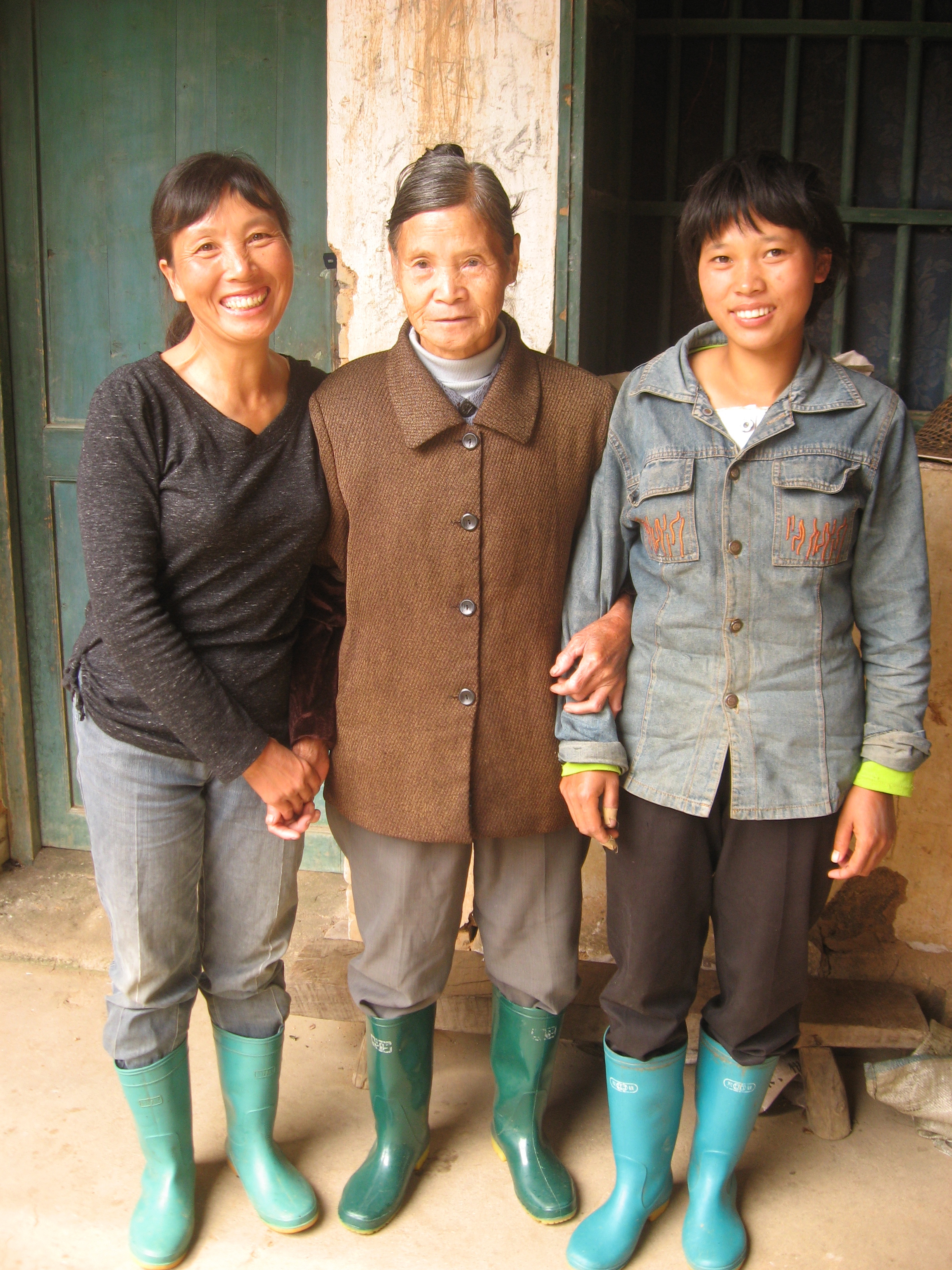
After a ten minute drive through town the buildings began to fade into vegetable plots, rice paddies, and the tea mountains. We turned onto the dirt road leading up to their home and pulled up to the drive way, and the Grandmother and youngest daughter (Nainai and Zhu Zixi) were already waiting in the doorway. I nearly tripped over myself rushing up the driveway as the older daughter (Zhu Zifei) came bounding down the stairs, and we all exchanged hugs through fits of laughter.

After dinner we passed the night in the parent’s room/their living room, drinking tea and chatting while a Chinese soap opera played in the background. The girls are both studying English in school, and Aiqiu explained that tomorrow she will go to her mother’s house to prepare food for the Spring festival, and she asked me to teach English to the girls in the morning while she was gone. I was happy to do so, and we all laughed as the girls asked me to teach them English animal vocabulary– as their animal requests started to get more and more complicated I needed them to act out the animals words they wanted to learn, which just led to more laughter.

Our English study session the next morning was awesome, especially compared to what I remembered four years ago where I had tried to to explain some mish mash of English vocabulary I had come up with on the spot while Zhu Zifei made a slight effort to listen, but mainly looked over my shoulder to watch the television that she had on mute in the background. Because she is now 14, English is a core piece of the curriculum that will have a significant impact on determining her entrance to high school and college.

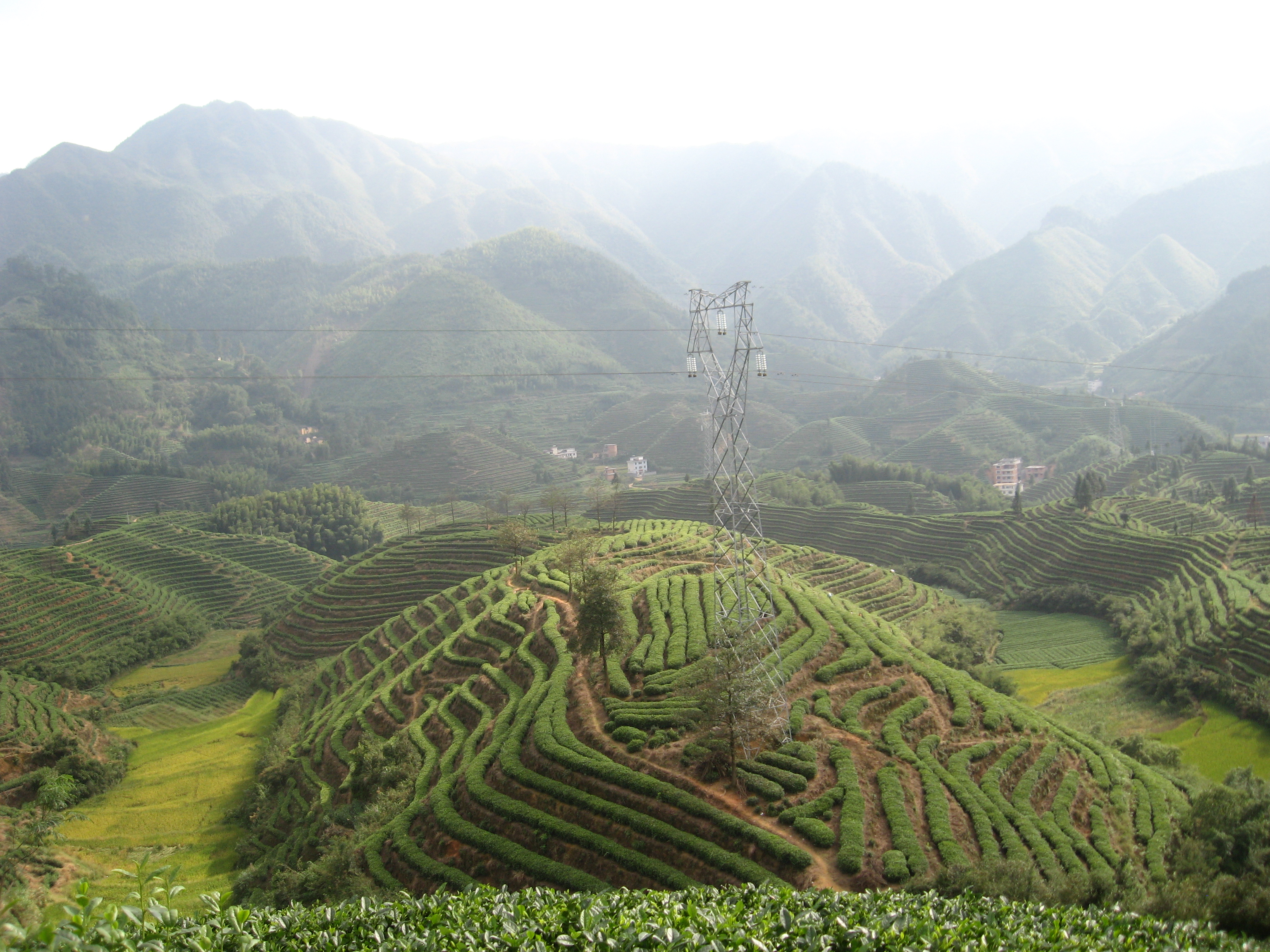
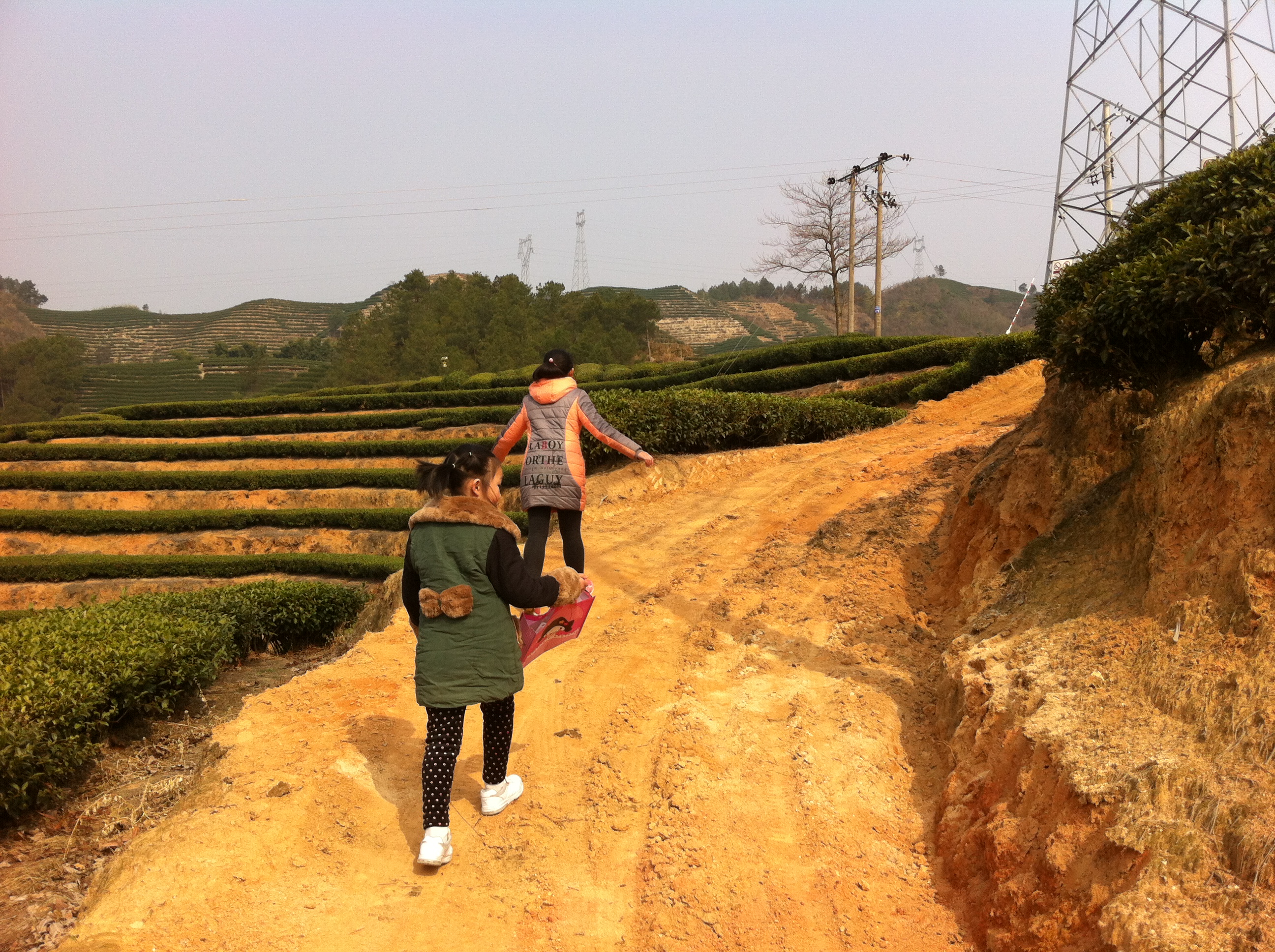
Later that afternoon we went on a hike through the tea fields…

TeaFIeldsGirlsHiking

TeaFieldsBroadView1 

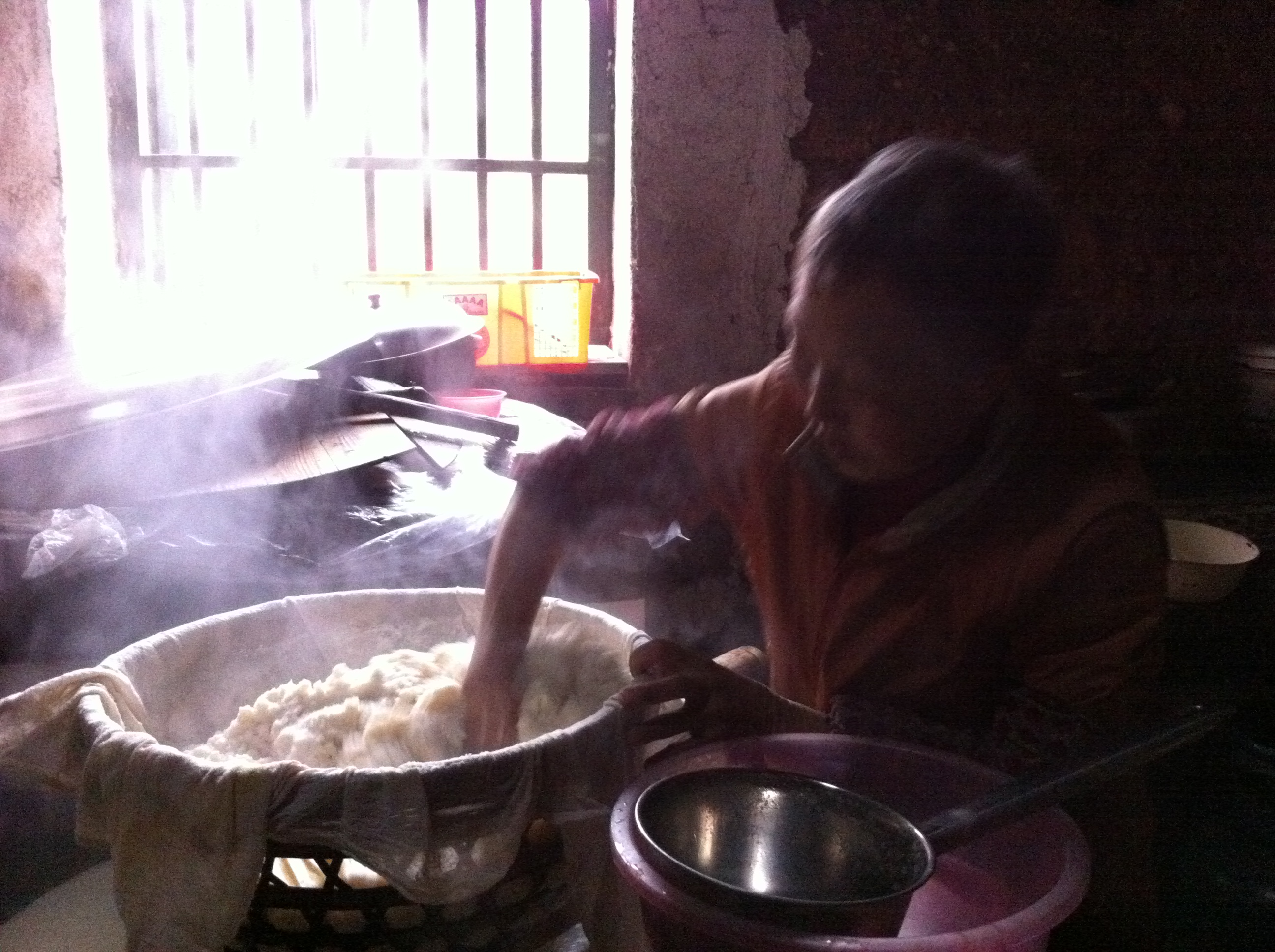
Then in the evening when the parents returned from where they had been preparing food for the spring festival at their grandmother’s house, Aiqiu invited me to the kitchen to watch as she and her mother-in-law prepared tofu. First they strained the tofu with water, then let it sit before straining it again:

CookingTofu9

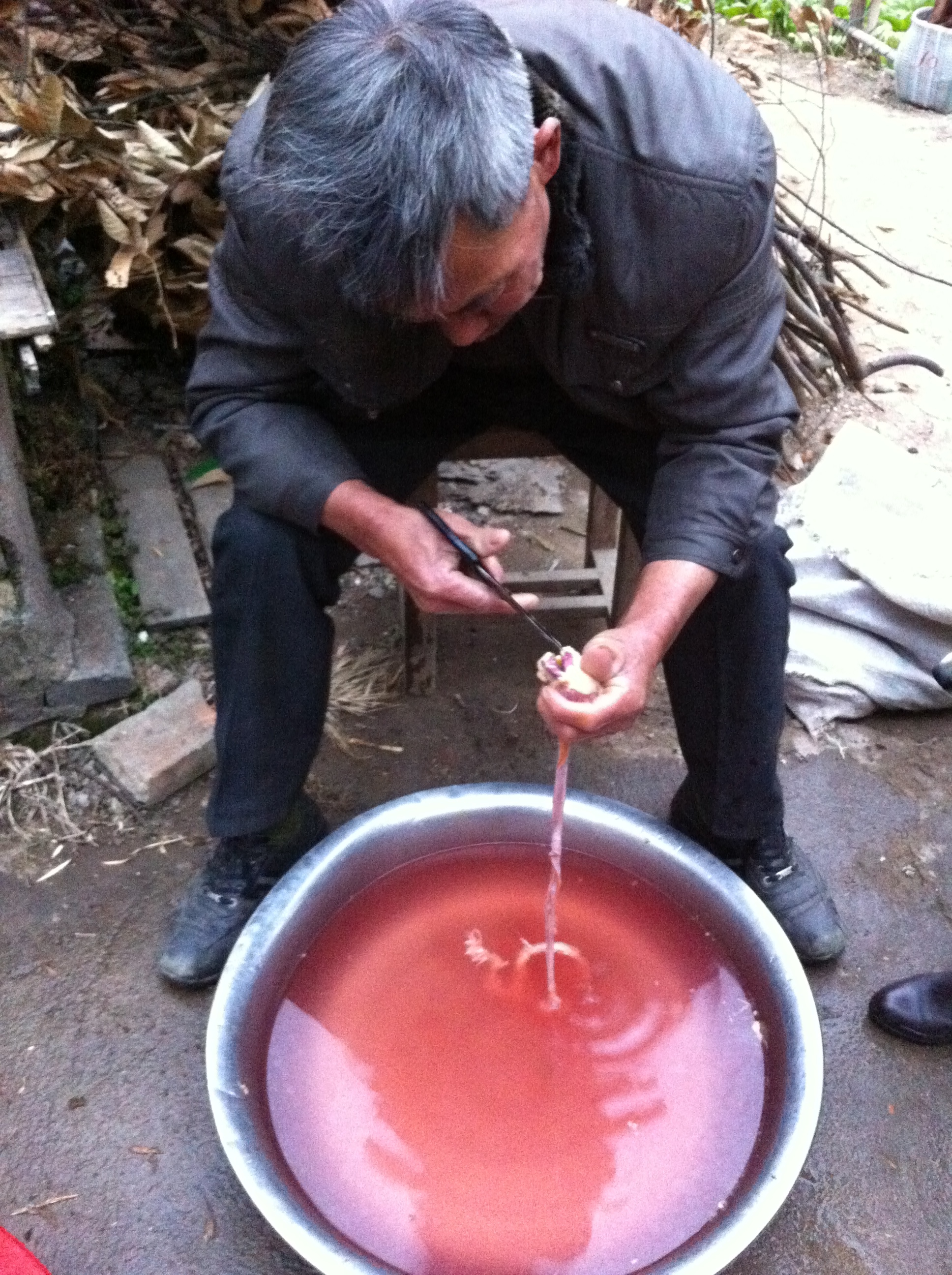
Meanwhile, outside Yeye (the grandfather) was cutting open a chicken gizzard for an offering they would make to the Land Gods as a tradition for the next day’s New Years Eve celebration:

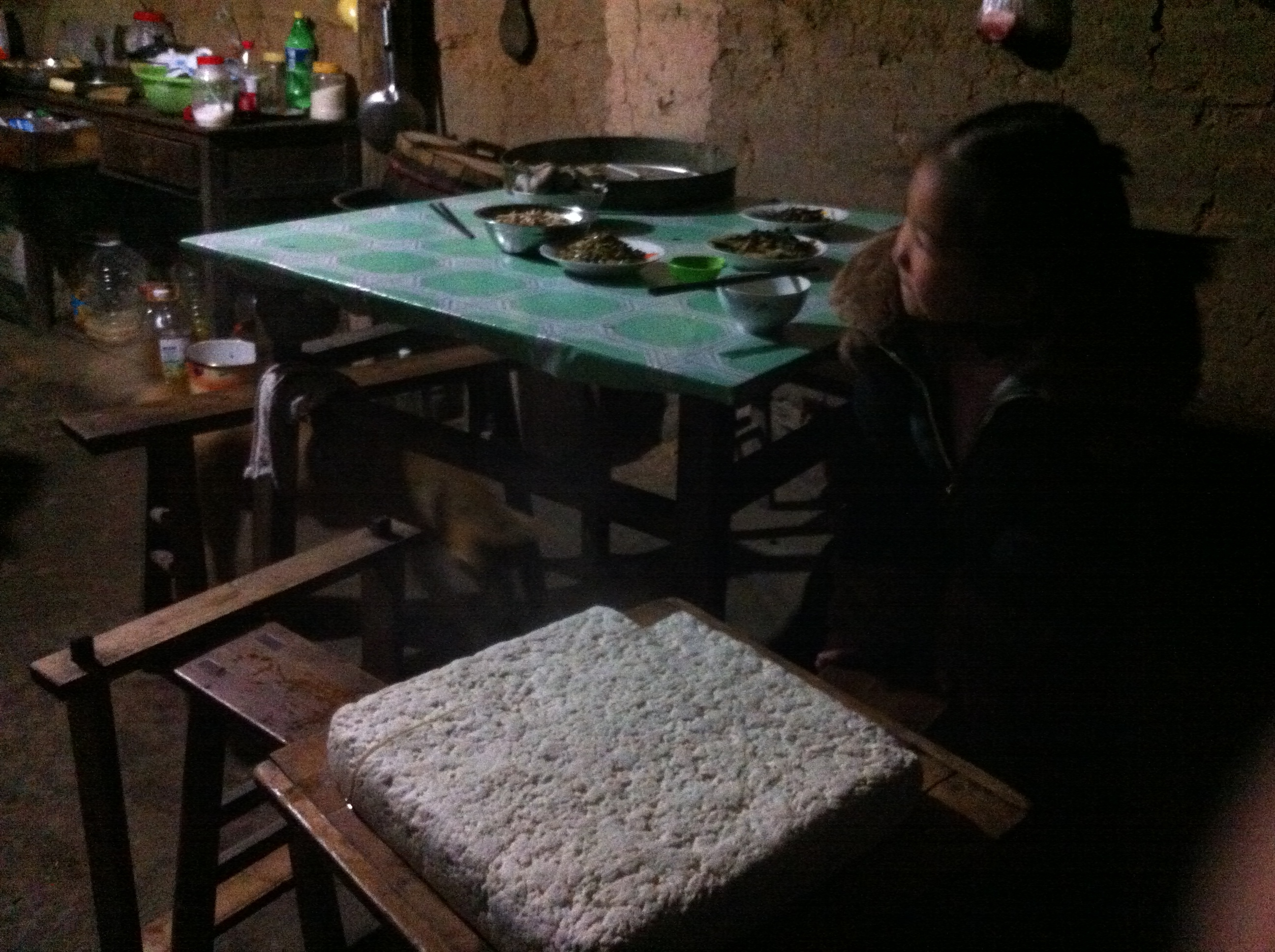
CookingTofuCuttingGizzard When all the tofu was collected in a square, they flattened it out to be cut and prepared:

CookedTofuSquare

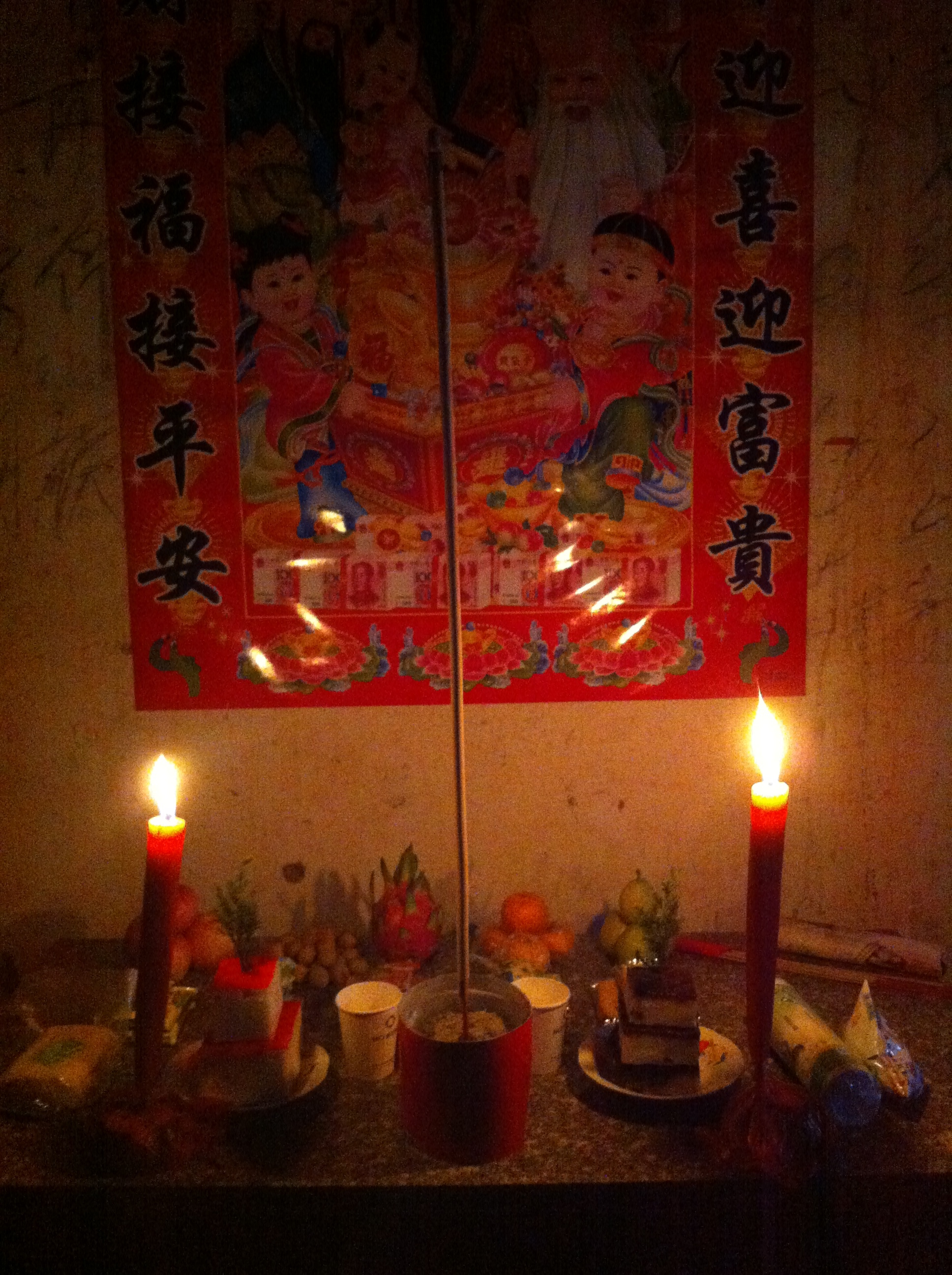
The following morning after breakfast I followed Yeye and Nainai up over the mountains and through the tea fields to where they have an alter situated into the side of one of the mountains. They carried a basket containing some bowls of food, a chicken, and what appeared to be the a part of a pig, along with some paper and candles.

AltarHikingto AltarHikingto2

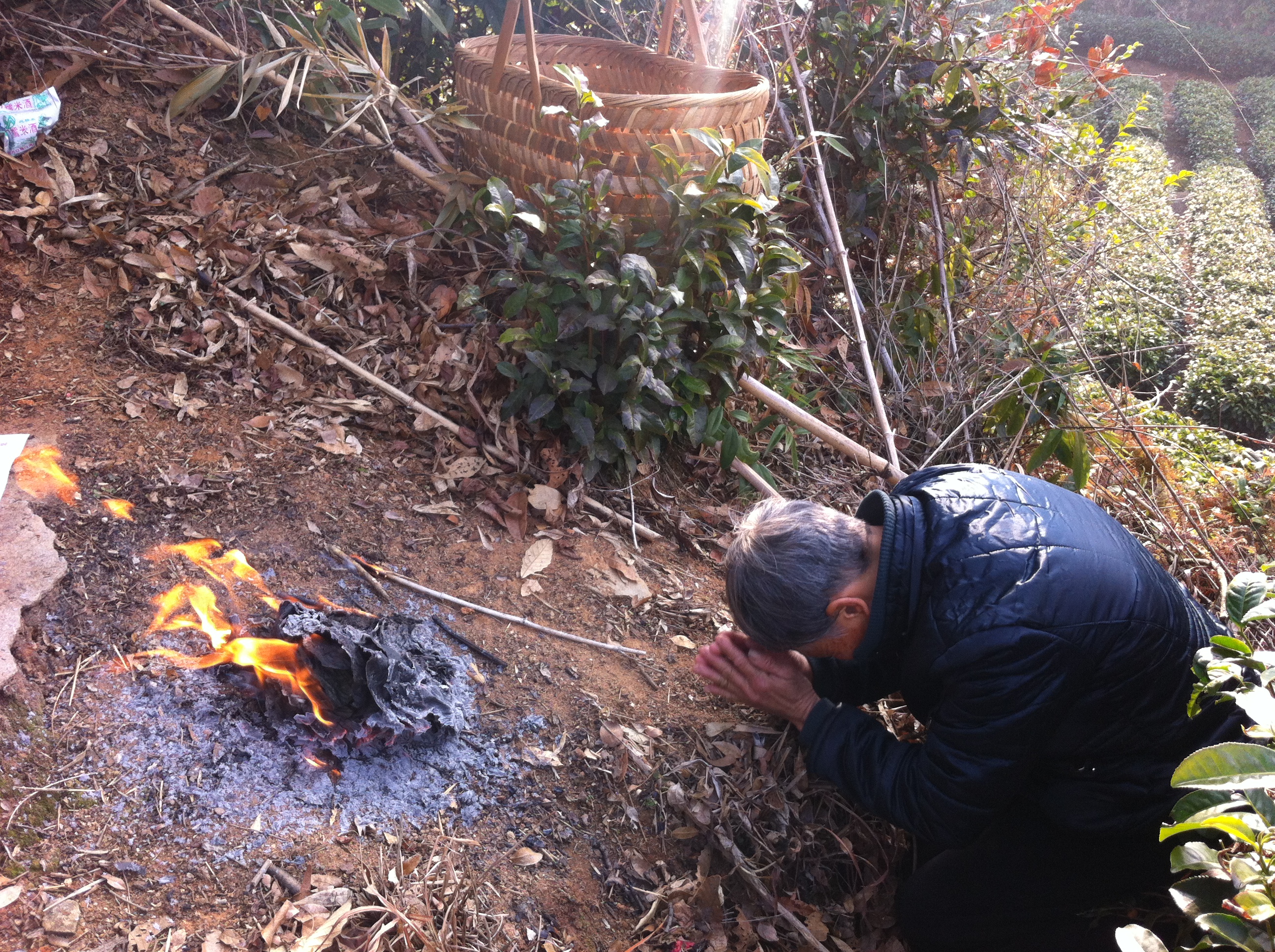
After laying the food out, Nainai lit the candles and incense, while Yeye took off further through the mountains. When he had disappeared over one of the peaks, Nainai lit the paper on fire they had spread out in front of the altar.

    AltarSet     AltarNainaiPrayingPaperBurning

I asked if this ritual was something they do just for the New Year, and she said they do it many times over the year, basically for every holiday, and they will do it again tomorrow morning as well.

DuilianJuziFeiPainting

The next day was New Years Eve (which is also when everyone celebrates their birthdays). That evening, after everyone had rushed about cleaning the house, the grandparents set the alter (pictured below) under the duilians that Zhu Zifei had painted earlier that afternoon (pictured above). Meanwhile, the mother gave the kids red envelopes with money and gifts. AltarNewYearsNight

Then, except for the grandparents who retired to their own bedroom, everyone crowded around the television to watch the Spring Festival Gala (what some from the US would equate with that Dick-something Rockin’ New Year’s Eve show). At 12am we all gathered outside to set off fireworks, and then went to the kitchen to eat cake. 

Aiqiu asked if we set off fireworks for Christmas, and I replied no, because for the most part the government has made it illegal to set off fireworks. She laughed and said that the government has also told them not to do it but no one pays any attention – that is just the way Chinese people are.

The following morning we were all allowed to sleep in, and after breakfast everyone dressed up (the girls in the new clothes they had been given the night before) and we set off for the temple that was in the mother’s hometown about a half hour away.

On the drive over, the streets were strewn with the red paper residue of firecrackers, and families and friends were gathered in groups in their driveways while kids played in the street. TempleEntering

When we arrived at the temple, Aiqiu told me that every year they come here,  but only for the Spring Festival. Inside most people moved from statue to statue, bowing three times while sometimes whispering a prayer. As we moved about the temple, she explained what the statues represented: some were for good health, others for wisdom, and the one room with two statues (pictured below on the right) were the land gods.

TempleStatue1 Temple

After we had made our way around to stop in front of each statue,  Aiqiu took me over to a large bell with a wooden hammer, and although I tried to decline the invitation to ring it, she insisted, saying that it would help me find a good husband. She then had me repeat the exercise at the drum on the opposite end if the altar, just to be sure.

I asked Aiqiu if every village will have a temple like this, and she replied that yes, but each village will have their own statues.

TempleMeRingingBell TempleMeBeatingDrum

The following morning we all piled into the car by 8, but all I knew was that we were going to Hushan, a place near Aiqiu’s home we had passed through on our visit a few days earlier, and that it would entail some boating. After winding our way through the mountains, and eventually turned onto a dirt road that led to the edge of the lake.We waited there along with groups of other families also carrying red boxes and bags typical for Chinese New Year gifts.

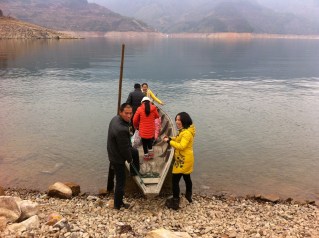
Eventually Aiqiu’s brother came buzzing around the corner in  a wooden canoe/boat (it was shaped like a canoe but had a motor attached to the back) and we all piled in and took off.

HushanGettingintoBoat As we rounded our way through the mountains we eventually came to a series of net grids attached to small huts on rafts. We followed Aiqiu’s brother as he hopped out onto the raft-hut, and then watched as he and Aiqiu’s husband waddled their way over opposing sides of the grid, pulling up the net that was submerged under the water as they waddled.

HushanFishingonGrid        HushanFishingFishAboveBoat

After they had waddled their way halfway down the grid, the father dipped a pole net into the water, and emerged with an enormous fish. We all piled back into the canoe-boat and took off further up the lake where we docked at the edge of a mountain with steps carved into the side, piled out with our New Years boxes and gift bags in tow, and hiked our way up the path until we arrived at a small village where Aiqiu’s brother, wife and son live with the wife’s grandparents. Aiqiu explained that everyone in this village makes their living from fishing as well as growing vegetables and tea.


The fish was immediately gutted and chopped into pieces, and Aiqiu and I sat side by side to tend the fire under the stove as her brother began to prepare lunch. Mostly Aiqiu took charge of adding more bamboo to the fire, but eventually she left me in charge while she went to help cook. While laughing, she asked if I knew how to handle the fire, and I, also while laughing, responded no. She thought I was joking (I wasn’t) and went to help her brother.

I assumed I just needed to keep the fire going, but it soon became obvious that I had no idea what I was doing when I miscalculated how much bamboo would be required to maintain the fire, adding way more than was necessary until Aiqiu and her brother, behind clouds of smoke and laughter, pulled me off fire duty. Luckily it was also time to eat so everyone was too distracted to make any comments about my lack of kitchen skills.

HushanPickingGreens

After lunch we said goodbye and piled back into the canoe, only to putter over to a small island where these wild green sprouts were growing. We hopped out and started picking, and Aiqiu explained that these are used in a traditional New Year cake that they prepare each year for the holiday, and they would use these sprouts to make the cake again next year.

That night at dinner Aiqiu explained that the house and tea farm is actually state-owned, and they just renewed their second 5-year contract with the local government to manage the tea production. Their farm includes 160 Mu (26 acres) of land while most other people in the village have 4 or 5 Mu (because the standard size for government allocated plots will be less than 10 Mu).

After these next five years she thinks they will move back to their previous home (that I had visited the previous day with Nainai). They are not sure if they will continue to pick tea or if they will find other work. A few days earlier she had also explained that when the youngest daughter enters middle school (and will then also live at school full time like her older sister), she and her husband may go to find work in Hangzhou or Shanghai.

She said that while this place is very beautiful, they may be able to find better work opportunities in the city.

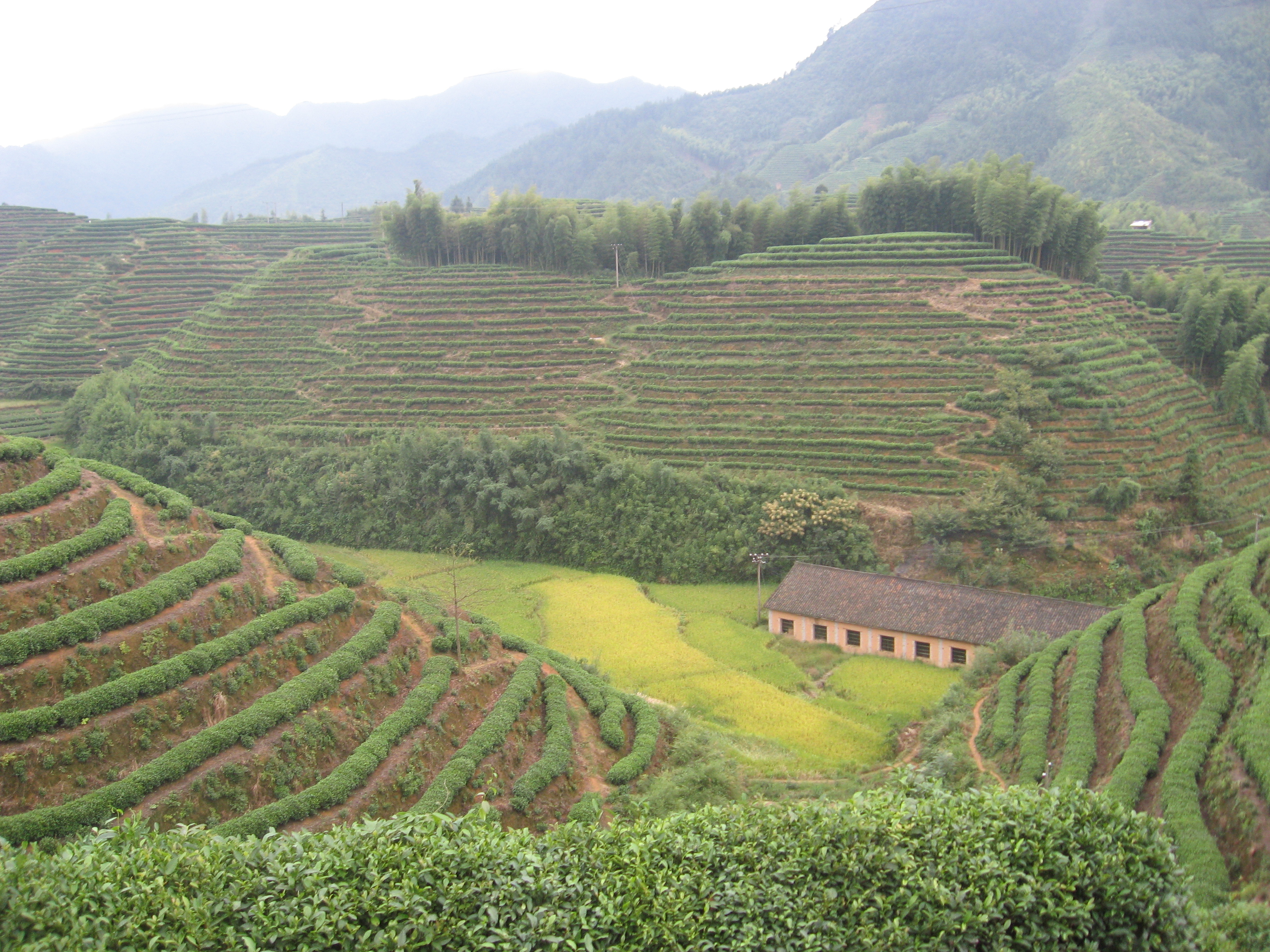
TeaFieldsHouse2

On the back left is the house, closer to the front is the tea processing barn.

Posted in Zhejiang Province | Tagged , , , , | Leave a comment

Suichang Part I: A Tea Farm, and my Brief Celebrity as a Local Waitress

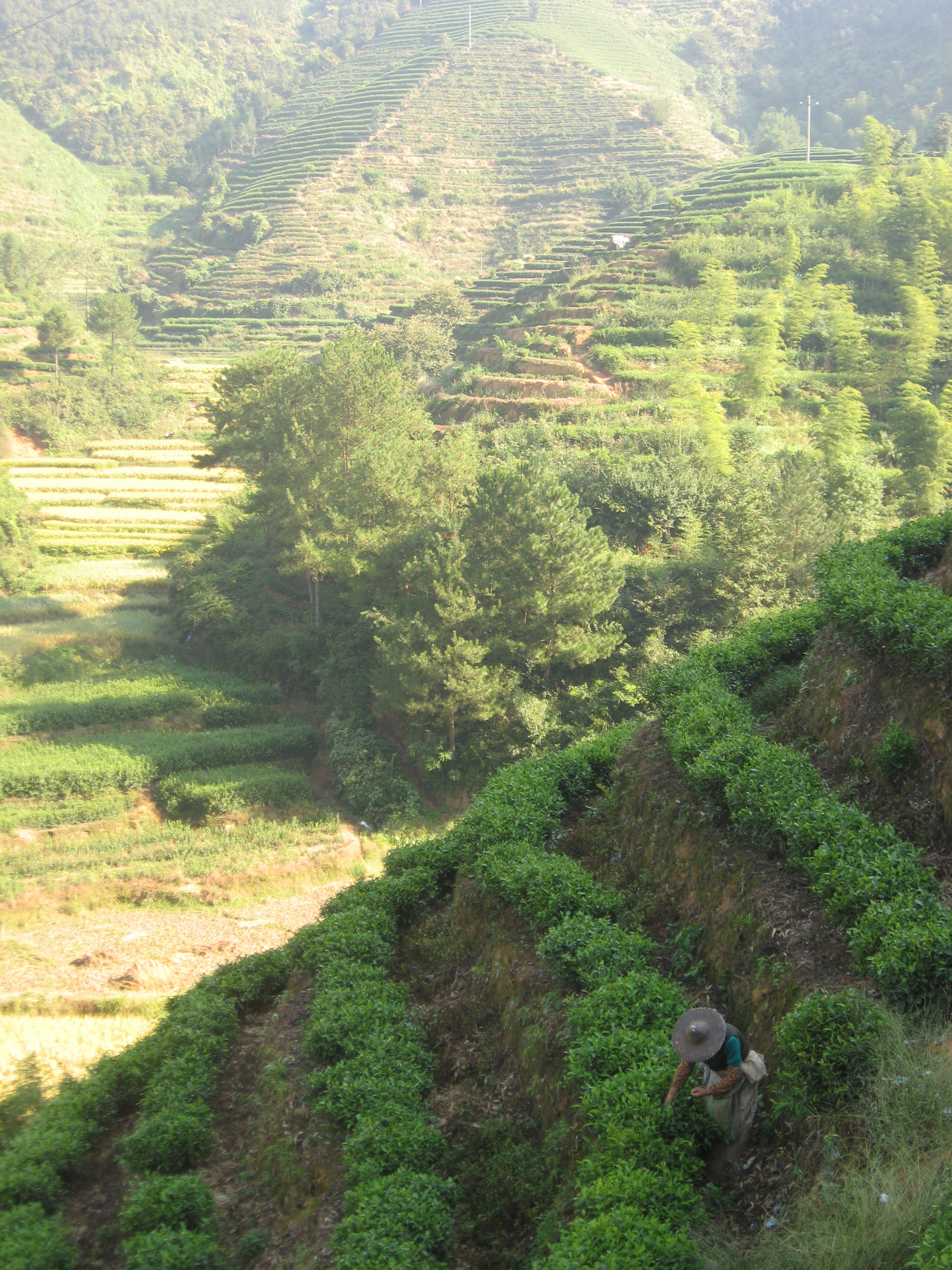
For my next 2010 field visit (following Julie’s family in Jiangsu province), I contacted a family that was running a large-scale tea farm; at least, definitely larger than the standard ‘noodle plots’ that rural families are allocated through the village collective (although the size of the plots depends on the demographics in each village).

TeaFieldMountains1 TeaFieldsMountains5 TeaFieldsMountains7

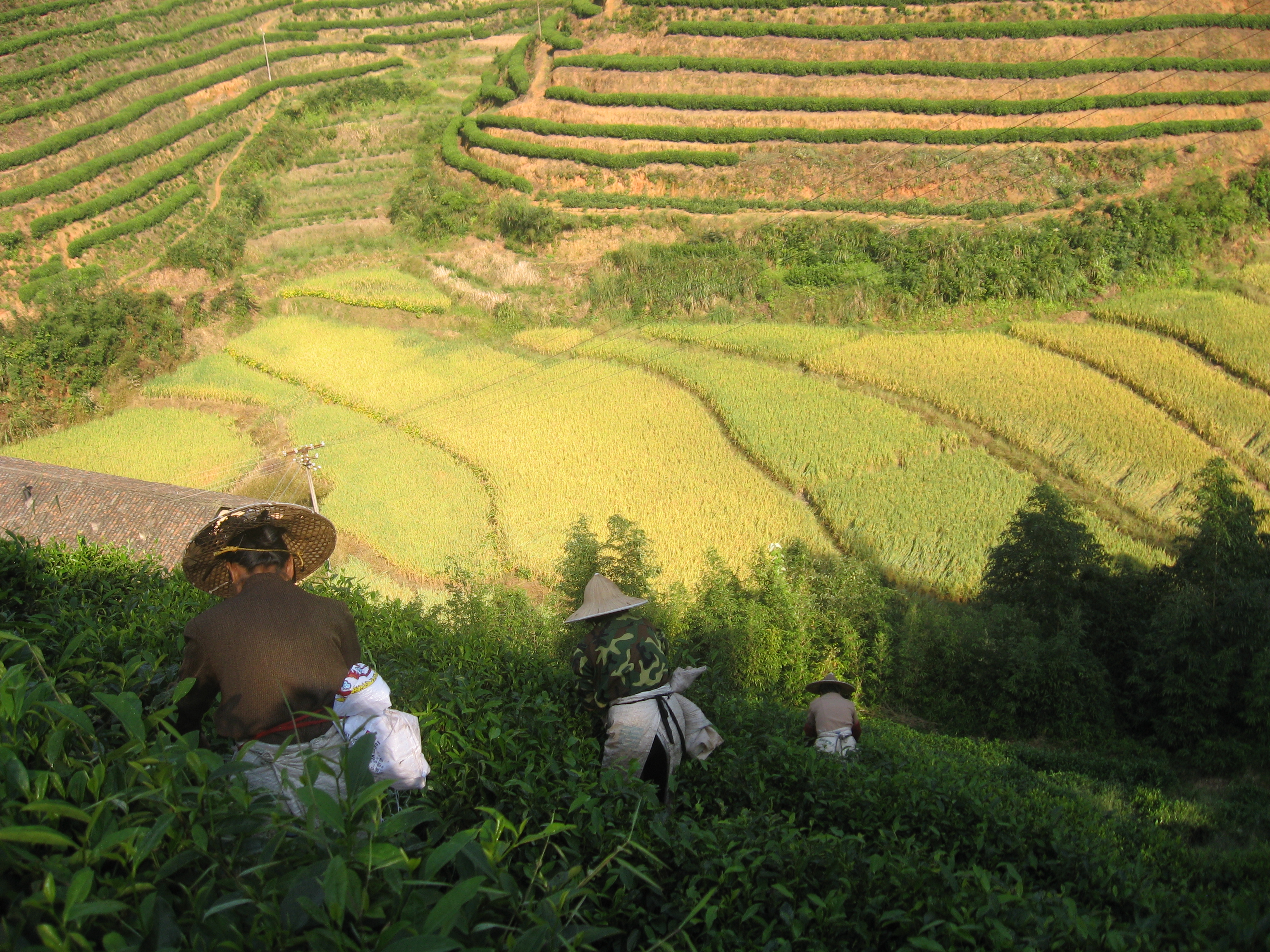
The family included a husband and wife, two girls, and the husband’s mother and father. During the peak harvest season from April to June the family would employ up to 50 tea pickers (all women) who migrated from more isolated villages in the county to work on the farm and live at their house (it is more like a compound with 15 extra rooms for the workers). At the time of my visit the harvest season was winding down, and there were about ten women still living with the family and working in the fields. This was the only family I visited that actually employed other workers on their farm.

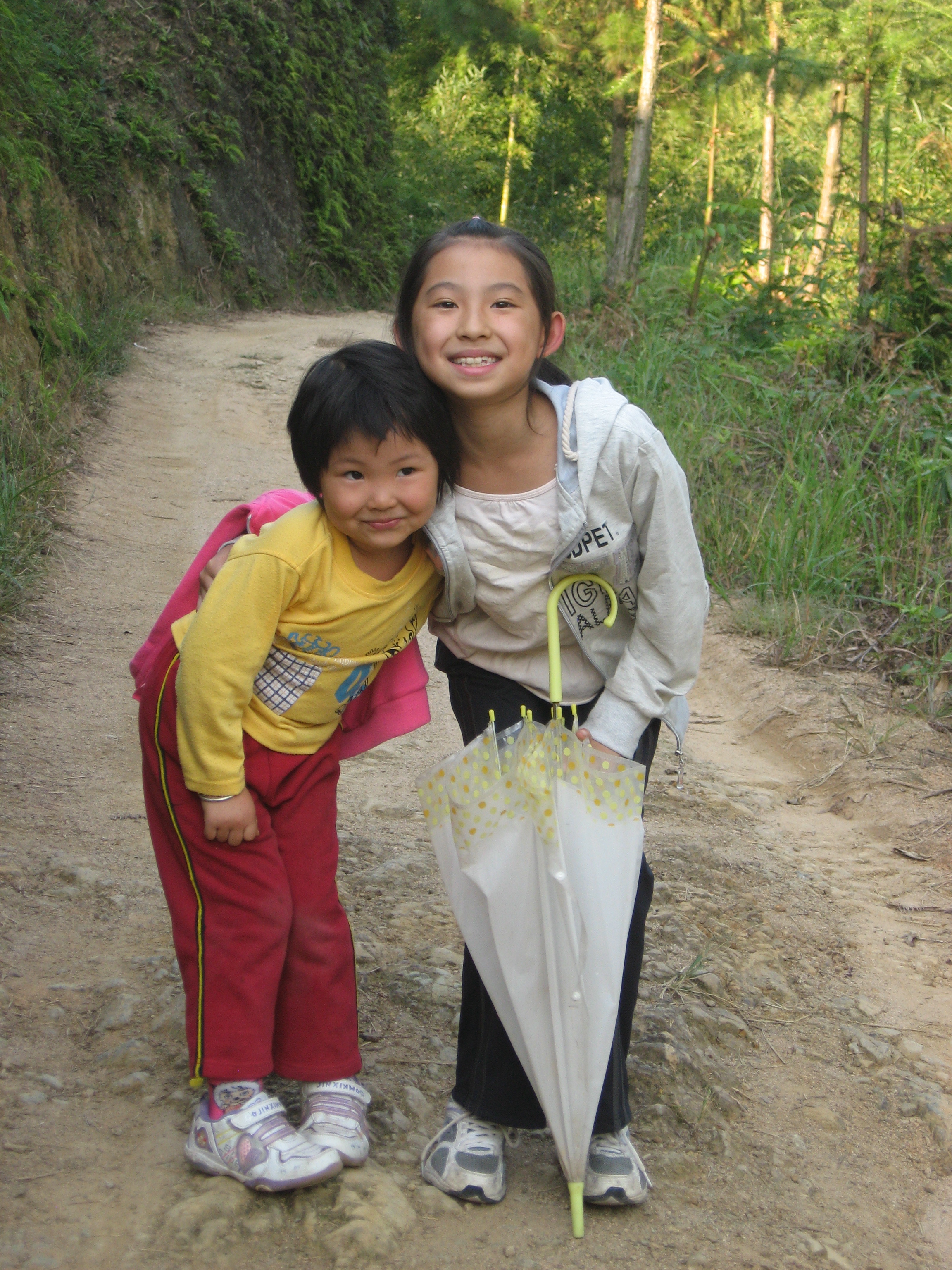
TwoGirlsonPath      MotherandFatherTeaBarn2

The first time I visited this family, they told me farming was their main source of income and they believed it was a sustainable form of livelihood, but they also felt their lives had improved little from the past and they still did not have enough money. When I returned to visit a month later the husband and wife were running a hotel/restaurant while the husband’s father and mother were running the tea farm and looking after the kids. This was significant because the land policy I was researching was encouraging farmers to choose between either becoming large-scale, full-time farmers by acquiring the land of other farmers in their village, or, if they did not want to farm full-time, to transfer their land to other farmers in their village and pursue full-time work in nearby towns or cities. However, this family was capable of managing a secondary occupation during the off-season in addition to running their tea farm (I happened to visit their restaurant on the opening weekend when there was a tourist delegation of more than 100 visitors).

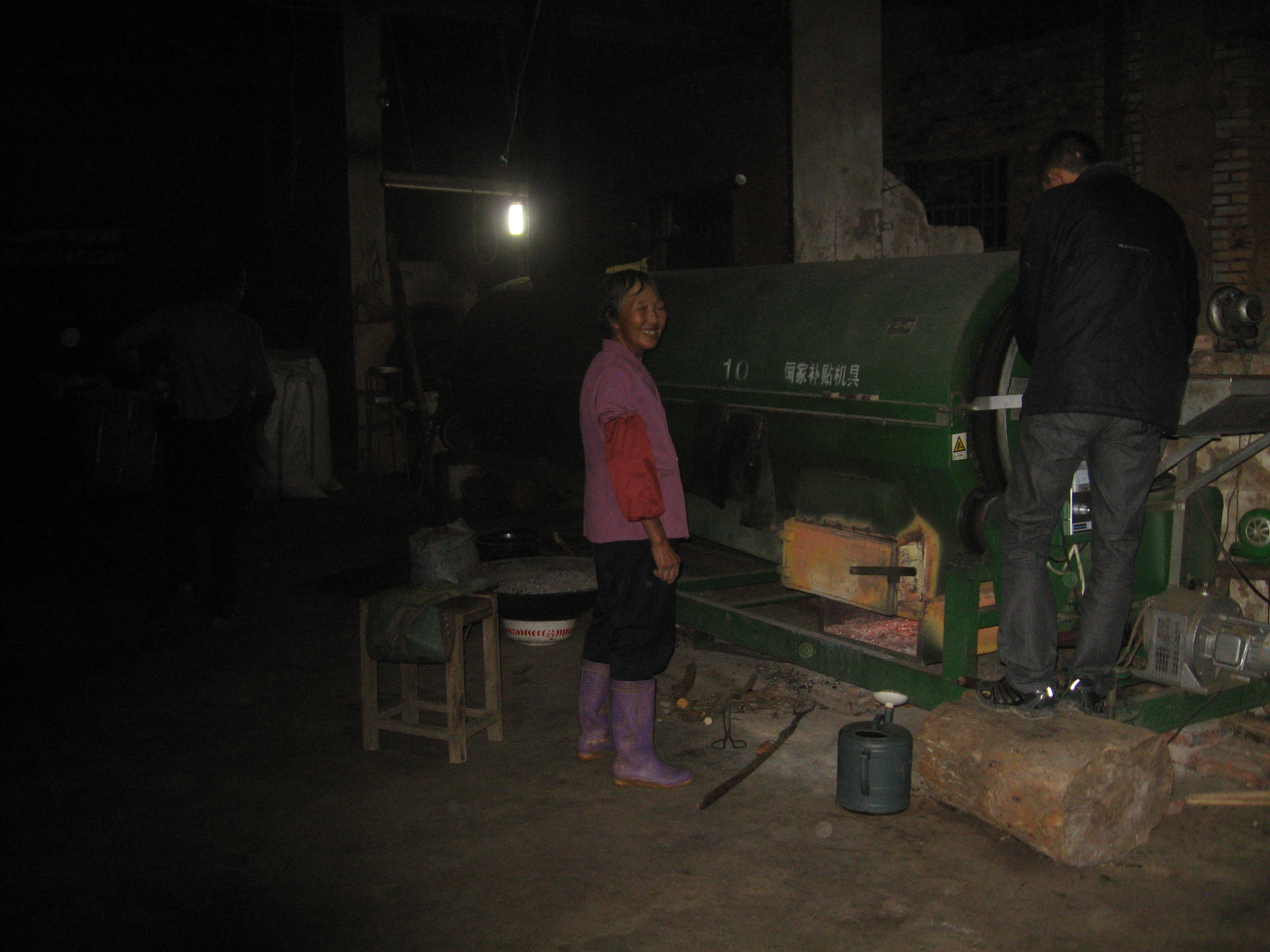
The father’s mother, still processing tea late at night.

The mother explained to me that while they are very busy during the tea harvest season – every day is the same and they must work from early morning until late at night (a few nights they were still processing tea past 9pm)—in the off-season they are not busy and she rarely had work to do.

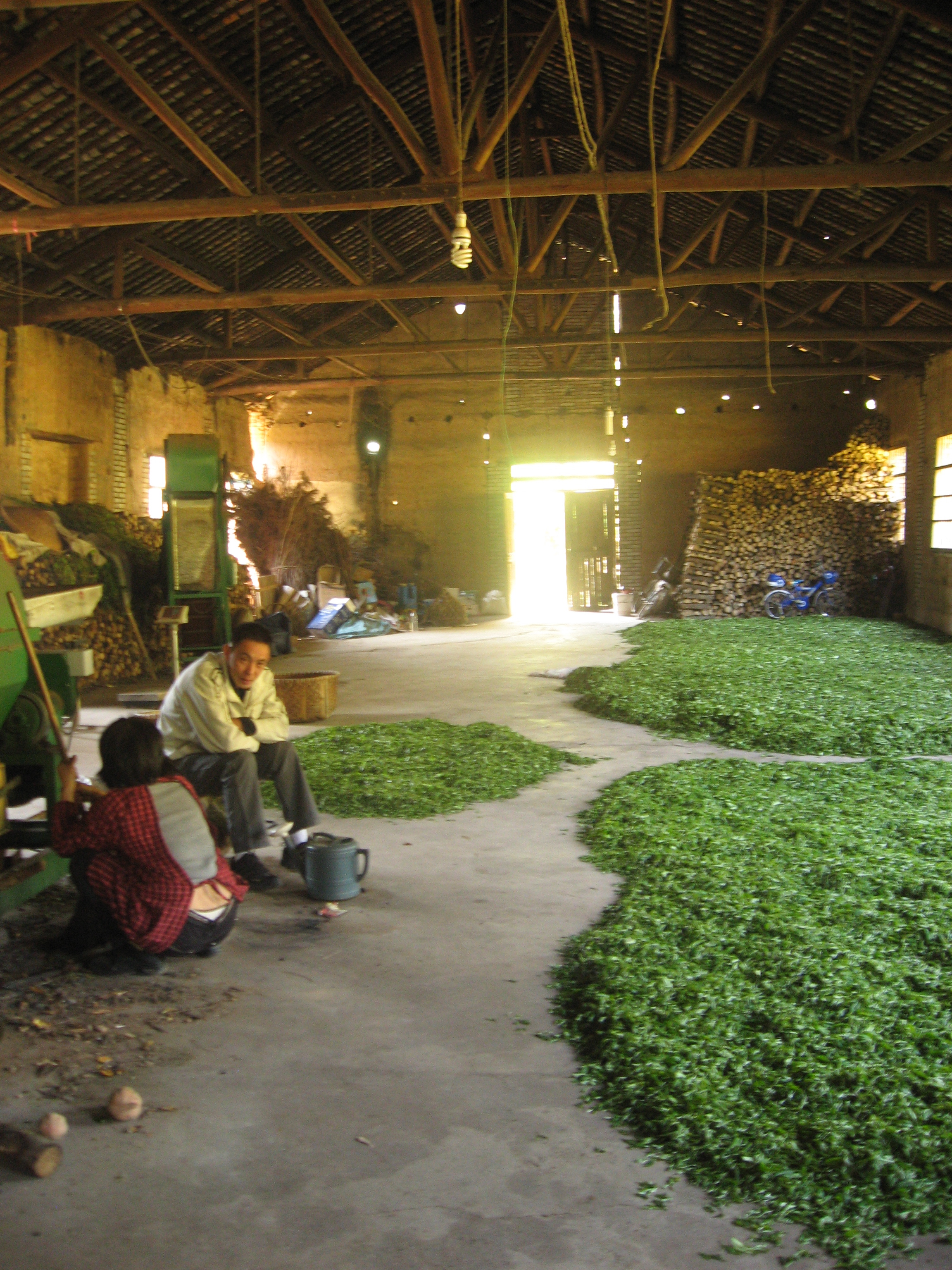
TeaLaidOutBarn3

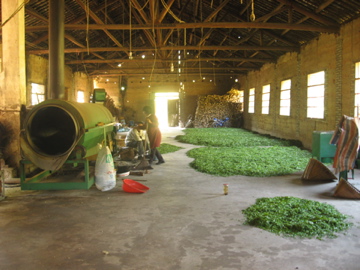
That’s the tea roaster on the left. On the right are the leaves laid out to be cycled through.

During my first visit, I tried to alternate back and forth between picking tea with the women in the fields (the mother-in-law also picked in the fields), and joining the mother and father in the barn at the base of the tea fields where the tea was processed. This mainly consisted of a large cylindrical burner where the leaves were roasted, and when they were reluctant to put me to work, I assigned myself the task of gathering the leaves when they shot out the back end of the burner and then stuffing them back in the front end as they needed to cycle through at least a dozen times before they were fully roasted.

WomeninRowTeaFieldsIt was while working with the mother in the barn that I learned the women work each day from 5:30am to 11:30am and then return to the fields again from 2pm to 6pm. They can earn around 100 Yuan per day (about $12 dollars at the time), based on how much the pick: before lunch and again at the end of each day the workers bring their baskets down to the barn where their leaves are weighed and the weight recorded before being tossed into the roaster. After roasting, the family brings the processed leaves to a buyer in a nearby town who acts somewhat like a middle-man, buying their yield in bulk and sending it on to be sold for retail.

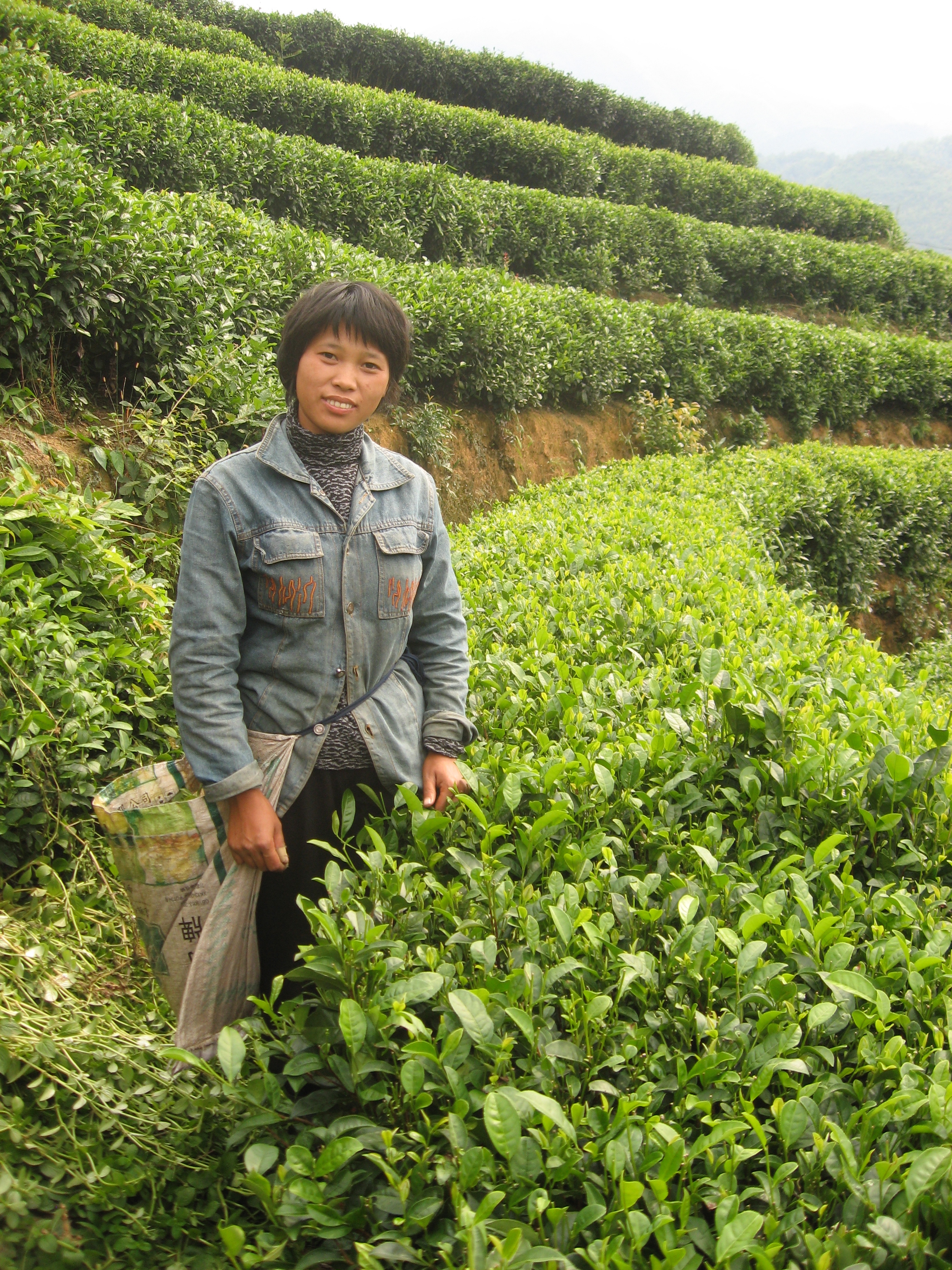
Lastphoto- LoneWomanPosingTeaFieldsWhen joining the women in the tea fields I learned that many of them were getting ready to return to their villages as the harvest season was winding down; they had been living and working on the farm for three to four weeks. One of the women I spoke with told me that during the off-season when she is not picking tea she works in a factory making clothing (her husband raises pigs); she said working in the factory was very difficult, more difficult than picking tea.

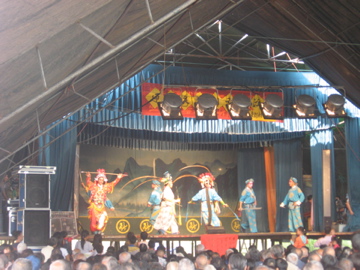
There are so many images  from this visit that still play out in my mind – from piling into the back of the father’s pickup truck with the girls to ride into town and watch the local staging of Beijing opera that was held outdoors in the town square, to hiking through the tea fields with the youngest daughter as she stream-of-conscious flooded me with questions about why I came to their farm while intermittently ducking in and out of tea bushes pretending to be a lion…

BeijingOpera   YoungestGirlLionFace

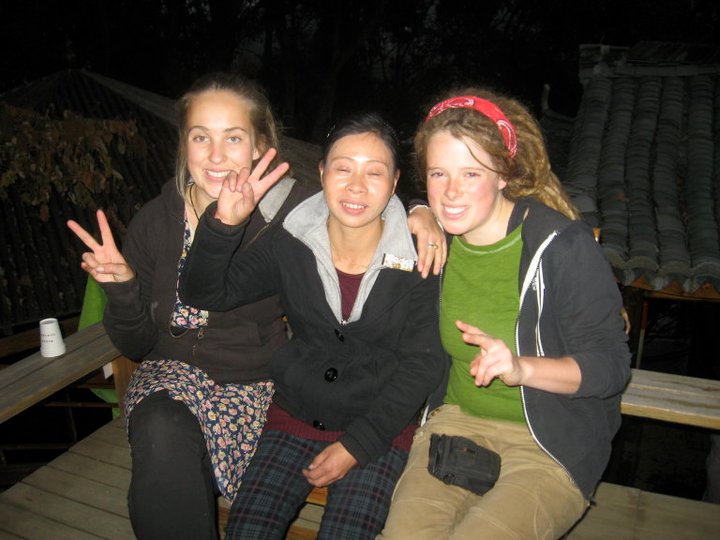
TeaPickers3WomenPosingBut there was one night I remember vividly – it was the night before the last few women who had worked as tea pickers were planning to return to their villages, and they invited me to accompany them for a walk down to where the dirt road merges with the paved road into town, and a small stand sells various snacks and drinks. The moon was bright enough that we didn’t take a flashlight, but the path was uneven as we walked, and one of the women linked her arm with mine. I listened quietly as they chatted about their plans for returning to their villages, and for a fleeting moment I felt as though I had crossed a threshold where everything that separated us seemed to fade, and we were just going for a walk to the store.

The second time I went back, I brought my cousin Leah, who happened to be visiting me at the time (she lives in New Zealand). Rather than returning to the tea farm, when we met the mother and father at the bus stop in Suichang, we piled into another small bus and they took us to another town about 30 minutes away where they had recently started their hotel/restaurant business. Hotels/restaurants like theirs were shooting up around the hot springs in the area to accommodate the growing tourism industry.

LeahMeSuichangWoman

When we arrived, it looked like they were preparing for the opening day, and it turned out that was exactly what they were doing. The mother told me that they were anticipating a “delegation” (I don’t know whether she meant an official delegation or just a large group) of more than one hundred people. Leah and I set to work helping to arrange tables and chairs, and before we knew it a reporter and cameraman from the local news station arrived and appeared very excited to find two foreigners working in the restaurant (I found out later someone had called asking them to do a story on the two foreigners working on the day of their big opening). At first the two reporters were inconspicuous, but pretty soon they were just following Leah and I around. It was kind of funny at first, but then, when the guests arrived and we set to work waiting tables, our task became increasingly complicated as the guests began offering us their seats and their food while we hurried from table to table with the cameramen in closer pursuit.

Most of the weekend is a blur of arranging tables, setting tables, waiting tables, praying I didn’t spill anything on myself or anyone else, and using any free time to entertain the young kids with any game Leah and I could dream up (we got pretty creative by the end) in order to avoid the reporters and having to take any more pictures with the older guests. On Sunday when the father pulled up in front of the restaurant with his pickup to take us back to the bus station, Leah and I, sensing freedom from the cameraman was near, made a mad dash for our bags and rushed out the door, only to see the reporters on our heels asking if they could hitch a ride back to the bus station too.

I assured Leah (and myself) that it would only be another 40 minutes til freedom, but when we got to the bus station I became stricken with panic when I couldn’t find our bus tickets, and not only was my panic caught on camera as I emptied the contents of my backpack on the bus station floor in a desperate attempt to locate them, but it was increasingly heightened by the thought that we might be stuck with the reporters for the next three hours. Minutes before our bus was scheduled to depart, I found the tickets in the inside pocket of my jacket, and we made a mad dash for the doors while I held the contents of my backpack in my arms, not wanting to take the time to stuff everything back in.

Apparently, we were scheduled to air on the local news station the next evening. Now that I’ve had some space to reflect on the absurdity of what the cameraman must have recorded, I would give anything for the narration that accompanied our news story.

Inserted-LoneTeaPickeronMountains

Posted in 2010 Rural Field Visits, Zhejiang Province | Tagged , , , , , | Leave a comment

Zhejiang’s 2013 Youth Environmental Leadership Summit

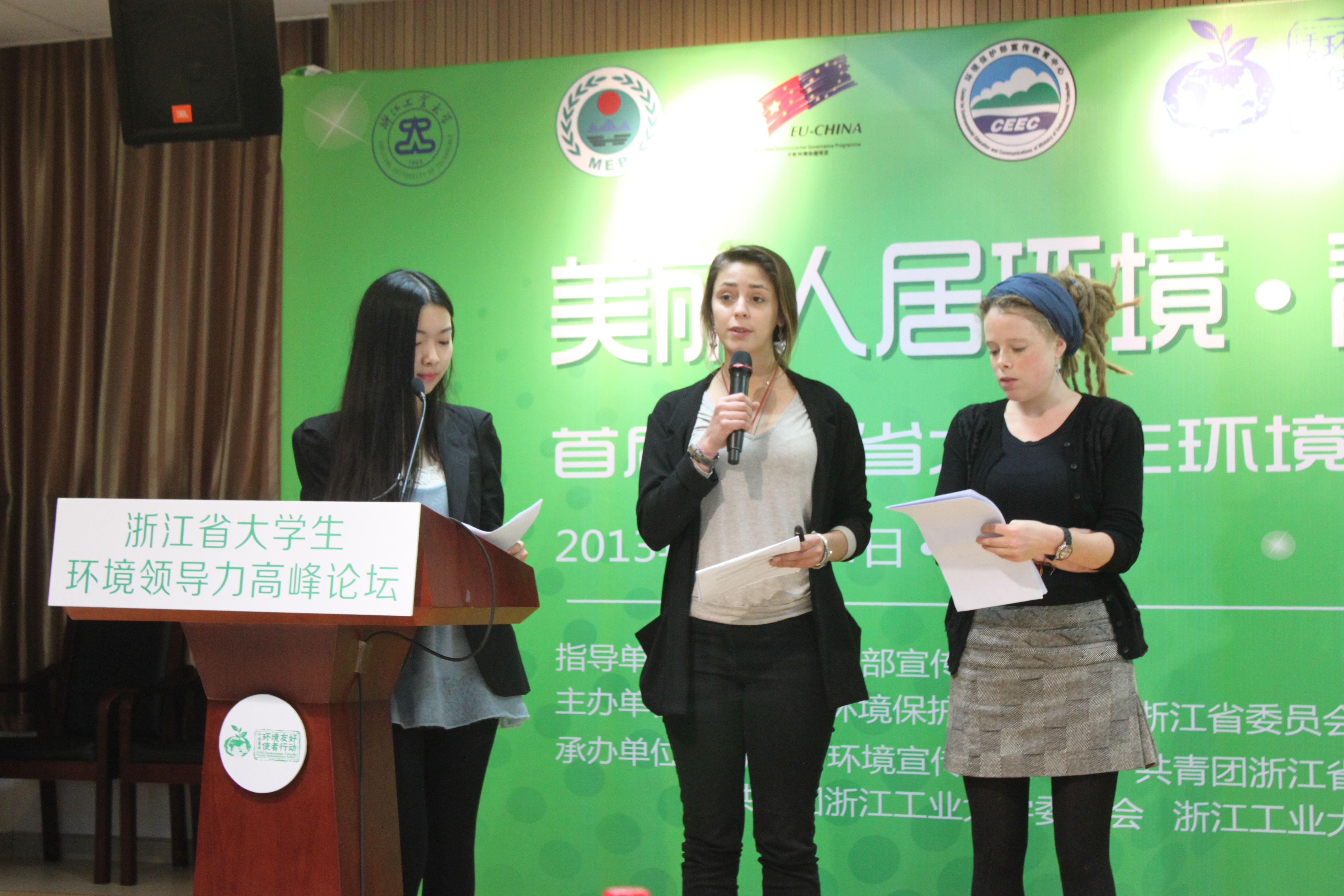
Coincidentally, just after I wrote my last post I was invited to give a presentation with another current Global College student, Paloma Criollo, and GC staff member, Eoife Huo, at Zhejiang’s ‘Youth Environmental Leadership Summit’ that is organized by the central and provincial government’s Environmental Protection Bureau (EPB). Our presentation was on youth leadership and on-the-ground initiatives in the international climate justice movement.

From Left: Me, Paloma Criollo, Eoife Huo, and the provincial EPB's director for media communications.

From Left: Me, Paloma Criollo, Eoife Huo, and the provincial EPB’s director for media communications.

This was an inspiring summit for two reasons. First, it demonstrated that the Chinese state, from the local to the central government, is not only talking about promoting an awareness of the climate crisis, but is actively seeking solutions that will address the problems. Second, it showcased and celebrated the innovative local initiatives that have already been started by youth to address the environmental crisis (in total, more than 130 people representing 26 different universities from Zhejiang were in attendance).

I’ll talk about our presentation in a second, but first I want to highlight some of the awesome projects other students have started (there were ten presentations in total):

One student shared the recycling initiative she started in her community. Working with a team, she studied people’s waste disposal habits by looking through their trash, then conducted intervention and education based on some of the problems they found. After the intervention they conducted a second survey of people’s trash to quantitatively demonstrate the impact their intervention had on the community’s subsequent disposal habits.

One student developed a simple water tester with household materials to gauge how clean your water is.

Another student conducted a research project to test which face masks actually work (this is a question anyone living in China asks themselves at some point or another, so its pretty cool that this student actually developed and tested a method to find out).

Generally, students presented a variety of school-based education programs they had started. One student made the great point of saying that in order to have a real impact (especially when you are starting out) you have to tap into networks that already exist – and schools are a great place to start.

7Our presentation, titled “Global Initiatives and Local Practice: The International Youth Climate Movement”, introduced the critical role youth have played in mobilizing people at the local level to take positive action on climate change, as well as at the international level through their participation in the UN Framework Convention on Climate Change (UNFCCC) negotiations. We gave examples of initiatives started by two U.S. youth environmental leaders, Adam Greenberg and Alec Loorz, and introduced the China Youth Climate Action Network as an example of how students can tap into a broader network in China that is active at both the national and international level.

IMG_2377 IMG_2388

We were even highlighted in some local and social media:

The Zhejiang News Online (the No. 1 local online news portal):  http://zjnews.zjol.com.cn/system/2013/12/14/019758736.shtml

Weibo: http://weibo.com/2446209797/Angpc73v1

as well as LIU Global’s newspage: http://www.liu.edu/Global/About/News/News/2013/December/LIU-Global-YouthClimate

It is no doubt encouraging that the Chinese government is celebrating youth environmental leadership. However, events and initiatives that target public awareness and encourage us to think about our individual carbon footprint, although necessary, can also have the unintended consequence of misdirecting attention from deeper, structural challenges.

For example, China’s environmental and economic goals directly contradict each other. While the EPB may try to limit carbon emissions, the state is simultaneously promoting urban consumption. As China transitions from an export-oriented economy to one that depends increasingly on urban consumers,  I wonder (in the context of a political environment that restricts collective activism) how the government intends to counteract the carbon emissions that are inevitable with this economic transition – especially given the state’s goal to integrate 70 percent of the country’s population to towns and cities by 2025. Unfortunately, at the central level the power of the Economic Bureau outweighs that of the Environmental Protection Bureau.

Even within a democracy where there is space for collective action, solutions that target individual consumption practices can sometimes pacify us into ignoring the more powerful culprits – the fossil fuel industry. As long as corporations can single-handedly jeopardize our future with projects like the Keystone XL Pipeline, these companies should be primary targets, and political pressure should be a key strategy. No matter how much I limit my own carbon footprint, the fossil fuel industry will continue to wreak havoc on the environment unless civil society pressures governments to enact regulations and implement policy incentives that curb their extraction practices.  Bill McKibben’s divestment campaign is a promising start.

Posted in Conferences | Tagged , , , , | Leave a comment