Rant: Climate Guilt

After Typhoon Haiyan decimated the Phillipines, killing more than 10,000 people and affecting close to 10 million people, the Philippines lead negotiator for the UN climate negotiations in Warsaw, Poland, Nadarev “Yeb” Sano, proceeded with a hunger strike until meaningful action was taken to address climate change. At the start of the conference he gave an impassioned plea to the assembled nations, saying “…let Poland be forever known as the place we truly cared to stop this madness.”

In the shadow of Typhoon Haiyan the primary issue of contestation became the lack of funds to help developing countries adapt to climate change and repair losses caused by extreme weather events and sea level rise. An index released on the second day of the UN climate conference showed that all ten of the countries most at risk for extreme weather events from 1993 to 2012 were developing countries (Philippines was listed number 2 but will likely become number 1 after this year’s typhoon).

On the last day of the negotiations, Yeb Sano said,

“The US, accounting for at least one-fourth of cumulative emissions, has a huge responsibility, a moral responsibility, to tackle climate change, not just to address it domestically, but also to be able to provide support for developing countries.”

In response to the question of whether, as the historically largest emitter of greenhouse gases, the U.S. owes the the most vulnerable countries some form of reparations, the lead U.S. climate negotiator, Todd Stern, replied,

“We don’t regard climate action as a matter of compensation or reparations or anything of the kind.”

While corporate sponsorship from some of the world’s biggest polluters set a dismal tone for any hope of progress at this year’s negotiations, one truly meaningful and inspiring action to come out of the climate talks was the unprecedented walk out on the second to last day of the talks by more than 800 members of environmental and development groups, NGOs, youth, indigenous peoples, trade unions, women’s groups and social movements (including my former Global College classmate, Adam Greenberg).

Winnie Byanyima, director of Oxfam International, said: “We are walking out of these talks because governments need to know that enough is enough. People around the globe have a right to know about the desperate state of these negotiations. The stakes are too high to allow governments to make a mockery of these talks”.

This was not a sign of throwing in the towel, on the contrary, they left wearing t-shirts saying “Polluters talk, We walk” and “We will be back #volveremos” (referring to next year’s climate talks in Lima, Peru), with an even deeper commitment to raising public awareness of the urgency of the situation, organizing as many civil protests as possible, and building a global social movement.

Feya Palmer from the Youth Climate Coalition, and one of those to walk out wrote,”In order to solve climate change, we need to become everywhere; we need to grow, both at home and internationally; we need to build movements from the grassroots, up into the conference centres. It isn’t a question of megaphones or meetings; the movement needs both… The important thing is that we don’t see the UN as the only solution.

Collective action is one critical piece of the solution that is desperately needed to address climate change; another piece is, as a pair of climate scientists from the influential Tyndall Climate Change Research Institute in England have called for, “revolutionary change to the political and economic hegemony”. Our window of opportunity to avoid the two degrees Celsius of warming that would lead to complete environmental disaster is so close to closing that climate scientists are saying our only option as this point is “radical and immediate de-growth strategies in the US, EU, and other wealthy nations.”

It is worth quoting one of the scientists, Kevin Anderson, at length:

In the short term, the only way we can get our emissions down is to actually reduce the level of energy we consume. Now, we can also put low-carbon energy supply in place, you know, power stations that are renewable—wind, even nuclear, as well. These are all very low-carbon power stations and other energy sources. But they take a long time to put in place. And we now—we’ve squandered the opportunity we had to make those changes. So, we still need to do that, but it’s going to take us 20, 30 years to do that. So what we need to do in the interim is to reduce the amount of energy we consume, and therefore reduce the amount of carbon dioxide that we emit.

And the levels of reduction we now need in carbon dioxide, and therefore energy consumption, are such that for many of us—for the wealthy of us, certainly—we can’t carry on as we’re going now. So we’ll have to consume less. And there’s absolutely no way out of that. The maths are absolutely clear. But it’s worth bearing in mind this is an equity issue, not just between the poorer south and richer north, but actually within our own countries, within the U.S. There will be many people in the U.S., probably the majority of people in the U.S., actually are relatively low carbon emitters, but there will be a small group of us, maybe 20 or 30 people in the U.S. or in the U.K. and in the EU, and our emissions are probably several fold, sometimes maybe even tenfold, the emissions of the average person that are there. So I think that this is not an issue where we all have to see less consumption. It’s those of us that consume well above the average that will have to see significant reductions in the short to medium term, once you put the low-carbon power stations in place.”

At the same time all of this is happening, the Chinese central leadership concluded their Third Plenary Session in November and announced “massive reforms” with economic growth a top priority in order to increase domestic consumption and transition away from an export-oriented economy.

Within the context of climate scientists’ calls for “radical and immediate de-growth strategies” in developed countries, the potentially devastating consequences of China’s transition in the exact direction we should be fleeing are evident.

However, despite China’s economic transition towards free market reforms, there still exists the rural collective land-use model. While collective land-use is often overlooked and underemphasized, if not outright attacked, I think the collective can offer other countries an alternative development model to the current political and economic hegemony. It is a model that not only empowers small (often the most vulnerable) land-owners and scales up production, but perhaps relevant to the climate movement, it creates a community of stakeholders to collectively resist injustice and implement practices that ensure long-term environmental sustainability.

The Chinese central government’s goal to increase domestic consumption through urbanization includes a plan to move 250 million rural farmers to towns and cities with the intention of integrating 70 percent of the country’s population to towns and cities by 2025. While this in and of itself could lead the collective model to become increasingly irrelevant, some western media, in collusion with vested elite interests, are actively promoting its disintegration.

When western media outlets say “strengthening land rights for farmers” is the solution to protecting rural farmers from land seizures, this is because they can avoid the term “privatization” while sounding as though they’re trying to protect rural farmers.

Privatization of land in China would have the following consequences:

1. it would increase farmer’s vulnerability to market volatility, manipulation, natural disasters, and land grabs— particularly by transnational corporations who would have deeper access to market penetration;

2. it would pit farmers against one another in a rush to extract once-communal resources before someone else does (as was evident in the early years of decollectivization); and

3. within the context of retracting state welfare benefits and infrastructure support for rural villages, it would pressure farmers to employ intensive land-use practices to increase short-term yields at the cost of long-term sustainability, or empower land development for private profit (particularly by elite interests), thereby amplifying food insecurity, land scarcity, and rural unrest.

On the other hand, maintaining or strengthening the collective:

1. provides a minimum security while buffering farmers from the volatility of the marketplace and perils of life as a migrant landless laborer;

2. is the foundation for farmers to work together to protect their land and resist injustice; and

3. promotes a shared responsibility among villages to implement practices that preserve the land’s long-term productivity and sustainability.

As reports of China’s economic reforms indicate (and promote) an increasing integration with the global economic hegemony that is destroying the planet, perhaps amplifying the power of alternative development models- like the rural collective, may offer some solidarity to the global climate justice movement.

Conventional thinking about modernity, growth, and development, so defined, is hopelessly, dangerously, and perversely blind to its structural deficiencies and devoid of real alternatives taken seriously in the centers of power. The future existence of the world’s people depends on breaking this utterly deficient style of developmental thought.” Richard Peet and Elaine Hartwick, from Theories of Development.

Posted in Conferences | Tagged , , , | Leave a comment

Jiangsu: Julie and the Fish Farm

As promised I will be writing more detailed accounts of each of my 2010 field visits, starting with WWOOF visit # in Jiangsu: Julie and the fish farm.
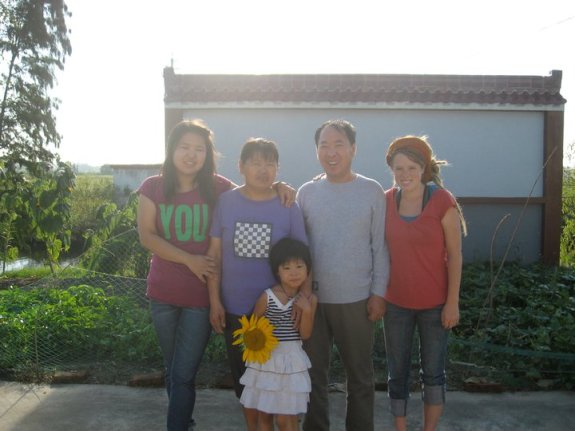
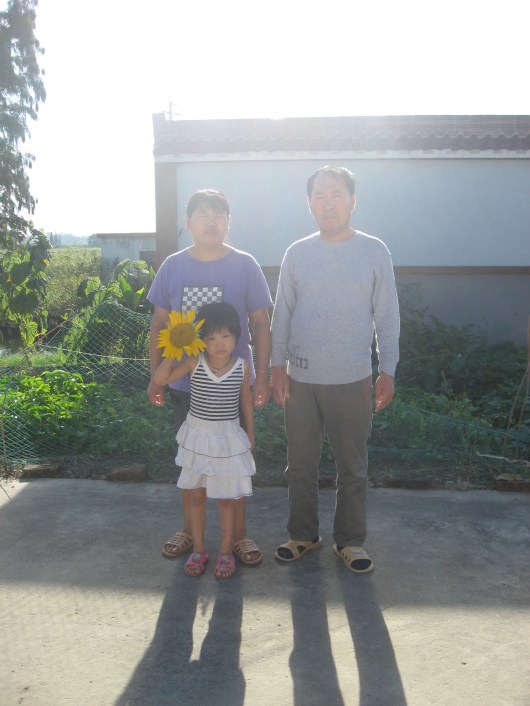
Julie&Fam

From left to right: Julie, her mom, Dad, Me, and Julie’s cousin’s daughter

Julie, my first WWOOF contact, was twenty-five and working in Nanjing as an interpreter for a German contracting company (but she said her job was more like babysitting for her foreign employers). She grew up in a small village just outside the central city of Yangzhou; during our initial correspondence when I explained my research questions and desire to help on her farm, she clarified it is not technically a farm, but that her parents have land-use rights to a few rice patties in the village (collective land is allocated to villagers based on the demographics in their village). Because rice-harvesting season was fast approaching, she said she would be returning home to help her parents the week of the Mid-Autumn Moon Festival (the actual day of the Moon Festival was September 22nd) , and I was welcome to tag along. I eagerly accepted and made plans to take the train to Yangzhou the following Sunday where she planned meet me at the station.

When I exited the station Julie was already waiting and waved me over. At first I couldn’t believe my luck of finding a contact that worked as an interpreter, but I was doubly-impressed when she spoke with a seamless British accent. She led me to the bus stop, and over the next hour it took to get to her village we chatted easily. She explained her cousin’s wedding had just happened a few days ago, but having already been introduced to Chinese wedding customs I knew this meant celebrations would still be going on when we arrived. Her cousin met us at the bus stop, and was easily discernible in the black Audi decorated with pink bows and flowers that are the trademark of wedding ceremonies.

We drove through a small town that appeared to be mostly one long street lined with a few small restaurants, a grocery store, and various small shops that appeared indistinguishable in any trade because they all displayed everything from pipes to bike locks to fluorescent light fixtures. Just as the buildings began to intermingle with gathering plots of rice patties we turned down a small road that was broken by a cluster of houses and ended in a sea of patties interspersed with six perfectly square ponds that I would later come to find are for fish farming.

IMG_0659

Here’s me with Julie’s cousin’s daughters.

We stopped at the cluster of houses and parked on the side of the road because the driveway was teeming with family members and friends getting ready to eat at the tables set with orange juice, baijiu, and small snacks. Julie led me to one of the far tables, which required I pass through a crowd of people that had all simultaneously turned to look at me, before seating me next to her father. I was then introduced to everyone at the table: mostly her immediate family and two young girls she said were her cousin’s daughters.  They all began questioning Julie about me, along with a few relatives that were curious enough to stand next to the table and listen. We had initially communicated using Mandarin, so she knew I could speak a passable amount of putonghua (ordinary Mandarin), but she warned me that her parents speak a local dialect and often do not use putonghua. I quickly realized this was also true for everyone in the village, because Julie responded to their questions by telling them to direct their questions to me using putonghua. Usually this encouraged a smile and a shy glance in my direction before continuing in rapid Yangzhouhua (Julie later explained that in Jiangsu, there are at least 50 dialects, and even within the Yangzhou area there are different varieties– people that live only about 3 kilometers from her family will speak in a different intonation).

Soon everyone’s attention turned elsewhere as the dishes started coming out. I’d prided myself by this point on becoming more or less accustomed to China’s diverse dishes, but quickly realized I had grossly overestimated my hutzpah when congealed duck’s blood, pig skin, and boiled chicken fetus appeared among various dishes of fish and fried vegetables. Julie, noticing my tendency to waver on the side of vegetables, explained that her mother and father suffered from high blood pressure and usually avoided meat as well. I was relieved that we would be eating mostly vegetables for the rest of the week, and simultaneously disheartened by my lack of grit, so at Julie’s grandmother’s offering I felt obliged to apportion myself a helping of pigskin before eagerly engaging Julie in conversation.

I described to Julie my curiosity with China’s national land-use strategies and policy initiatives; particularly how those strategies  are filtered down and implemented at the local level, and whether rural farmers are on board or resistant to these initiatives. I then asked her about the village’s relationship with local village officials, and she replied that they sometimes get together to have meetings and they seem just like neighbors, but the county-appointed officials get to decide who and how to use the land. For the right to use of a plot of land they will have an open auction, and the one with highest bid wins, but perhaps there will also be unseen deals.  These officials can also decide if they need the land for public use, but then they may keep a lot of the money instead for development. Like when they build roads, they will construct them a few meters less than they should be so they can save money on concrete. In the west and south they [the governments] now have plans to develop farmer’s lands, so they move the farmers into compounds and flats they constructed while providing some compensation. Then these people must find jobs.  Specifically, she described her Shanghai cleaning lady that used to own a farm but was forced to look for alternative work when she was relocated by the government.

She said so far the people in her village have been lucky because developers haven’t come yet, but in the future they probably will have to sell their land-use right (Julie later explained that she doesn’t want to sell the right to use the land, but has always thought that when she retires she would like to return there to live and grow food). I asked if the villagers take any action to protest or resist reallocation/requisition of their land and she said no, they don’t.

At this point Julie’s cousin and his wife began visiting each table; her cousin toasting the men with a cup of baijiu (although Julie whispered to me that her cousin’s glass was probably just water to avoid any drunken display), while his wife received money from her husband’s family members. Julie laughed and said if she ever needed money she would just get married, then somewhat more seriously added that now that her cousin was married her relatives will all be questioning when she has plans to marry.

As we continued eating Julie motioned to her Dad who was seated to my left, and he raised his glass in a ganbei (cheers) motion to me before helping one of the girls that was seated on his lap to a piece of food on his plate. Julie then explained that her father had suffered a stroke a few years ago and was still slowly recovering.

By the time the last plates were brought out most people had already finished eating. The tables had been set up on the cement patio in front of Julie’s cousin’s and wife’s house; directly to the right was Julie’s house – two stories with a cement patio in front and a small garden out back that gave way to a bank and shallow stream. We made our way inside and she showed me the bedroom we would share before leading me to the bathroom that was situated in the backyard above what I concluded must be the pigpen given the intermittent sounds coming from below.

That night we fell asleep on a bed covered in bamboo mats and draped with a mosquito net. We asked each other questions about our families, and this soon led to a discussion of the one-chid policy, as Julie herself is an only child. Julie explained that she would like to have siblings, and that because she was a female her parents were allowed to have another child, but that they decided they only wanted one. Although the policy is much less restrictive now, it used to be very stringent– even if someone was willing to pay the fine they would have to hide away during their pregnancy.

The next morning we woke up to Julie’s mom frantically calling for us to help move the rice inside– the sky had clouded over as if it might rain, and the rice was still laid out to dry on the patio from the previous day, so a sudden rainstorm would surely ruin it. We quickly went to work moving the rice from the large cement patio to a large metal cylindrical container stacked in a small shed off to the side of the patio. Then, just as we were close to finished the radio broadcast (followed by a loud groan from Julie’s mom) announced it would not rain, so we rapidly laid the rice back out again.

IMG_0647

One of the family’s rice plots, after it had been harvested.

By the time we finished the sky had cleared so Julie and I set out for a walk with her dad. While he quickly strode ahead of us, picking up his knees in a rapid gait, Julie and I lagged behind as we talked. She explained that her village has twenty families – about 100 people. They each have their own small plots to work, but like her dad, most people also work in other forms of business other than the farms. Before her dad had a stroke he used to go to places like Beijing to paint and would only come home for the harvest season. This practice is typical of many rural families; there are now an estimated 260 million migrant workers in China.

Despite previous regulations restricting rural to urban migration, the government is now encouraging rural citizens to find work in local towns and cities with incentives such as subsidized housing and permission to transfer land-use rights without going through local government officials. And, most recently: an incredible plan to move 250 million farmers to cities. By encouraging farmers to move to larger towns and cities the government hopes to integrate many of the ‘noodle’ plots that now compose rural villages since the 1978 reforms and the allocation land-use rights to individual families (while remaining collectively-owned). Theoretically, integrating land plots would result in more efficient grain production, however policy implementation at the local level often involves a much more complicated dynamic than China’s perceived top-down chain of command might imply.

IMG_0662

The fish-farm ponds.

As we continued walking Julie pointed out the ponds I had noticed when we first arrived and explained that the fish farm belongs to the community, but collectively they rent it out to people from other villages and then split the revenue to invest in irrigation and other farming necessities on their individual plots. She said it is not possible for people to make a living just from farming; many villagers get jobs in the factory or other places, but still return home for the harvest season. Like many women in the village, Julie’s mom works in a local toy factory making the eyes of dolls and stuffed animals. During the harvest season she wakes up early to lay the rice out to dry before work, and still returns home during her mid-day break to quickly eat lunch then turn the rice over.

After we returned to the house and sat sipping tea at the kitchen table, I listened while Julie and her father described the changes that have occurred in the village. Because her father traveled to the city to work, their family always had enough money and could often afford commodities others in the village couldn’t: twenty years ago theirs was the first house in the village to have a telephone, despite having to pay China Mobile an outrageous installation fee of 3-4,000 Yuan. Julie then recalled a conversation she had with a taxi driver who also had installed a telephone before others in his village– in an entrepreneurial spirit he decided to charge a minimal fee like one yuan per minute for other villagers to use his telephone, and that way he easily made a return on the initial costly installation investment.

In 2005 Julie’s family was also one of the first houses to have a refrigerator; Julie’s tone turned nostalgic as she said the things people make now are not as good as before. Their fridge works fine, but the refrigerator others have will undoubtedly have problems and people will need to be called to fix them. She pointed to the wall, and said there are no cracks, but her cousin’s new house has cracks and leaks, and the quality of cement isn’t very good; “people will do anything now to make a profit,” she concluded.

Turning to the subject of medical care Julie said her village is a model for health care and the pension program, but the local medical care is still inadequate; instead her family must travel forty minutes to the hospital in Yangzhou because the better doctors will not visit the village. Although, she said in the mountainous regions the situation must be much worse.

As she continued explaining the changes her village has seen, she reiterated what her grandfather had told her: life used to be very hard; during the Great Leap Forward they [farmers] had to give too much grain to the government, even when there was not enough food to feed their own families– at one point he had to rely on pig grain for lack of other sustenance. Before the reforms, she said, food was worth more than money.

In the evening, after another extravagant dinner with Julie’s relatives and neighbors, I confided in Julie my affinity (at this point more like a compulsion) for running and she offered to accompany me on a quick jog. We set off on the same path we had taken that morning with her father, and on our way back I realized it was easy to maintain almost the entire cluster of houses that composed the village in my periphery view. While observing the size of the village, Julie said there is a policy that if a village has less than twenty families the government will require everyone to move to another compound to make room for industry or large farms.

The following morning Julie and I accompanied her dad for a walk to a nearby village. This village had a small park designed for exercise, and it was paved with small stones protruding from the cement. I quickly learned these stones were used for acupuncture as her father removed his socks and shoes and gently began to walk over them, albeit gently as though he were walking on hot coals. Meanwhile an older man was pushing his granddaughter on a nearby swing, and noticing my presence he said, “now you have seen the dark side of China.” Julie laughed and replied “not really”, then turned to me and explained that for the Chinese everything is about saving face, they want foreigners to stay in the city so they only see the ‘bright side’ of China.

The path we followed back to the house was bordered on either side by rice patties being harvested by men using machines. I asked Julie if these men were only cutting their individual plots or if everyone helps each other harvest their rice patties, and she replied that neighbors will often help each other finish the work– for example her mom was going to help cut a neighbor’s plot– but the machines we observed the men in the field using actually belonged to people from another town: a few villagers collectively rented these machines, and then paid these men to come from the inland province of Anhui and cut the rice.

Later that afternoon we picked up all the rice we had laid out to dry, and again filled the large metal canisters we hadn’t previously finished filling before setting off to a neighbors house to gather the rice that had been cut by machine earlier that day. Julie’s dad owned what they called ‘a tricycle’, really a bicycle with a two-wheeled trailer attached in the back, that could be used for hauling anything of substantial size or weight, including rice. At the neighbor’s house we worked filling the tricycle’s trailer with rice and Julie’s dad would then ride the tricycle back and forth to their house once it was full.

That's the tricycle in the background.

That’s the tricycle in the background.

Wanting to be as helpful as possible, I attempted to take over cycling duties from Julie’s father after he had carted a few loads back and forth. Julie abruptly stopped me and said, “you can’t ride a tricycle,” but she let me attempt anyway and see for myself. I took off, and much to the village’s bemusement rode the tricycle back to Julie’s house while neighbors watched and gave me a thumbs-up sign. As I rode back to pick up another load of rice three neighbors even approached me to comment how clever I must be to know how to ride a tricycle. Initially anxious they might be patronizing me, Julie abated my fears and explained that many of them are unable ride a tricycle: she and her mother both can’t ride because learning to first ride a bicycle had inhibited their tricycling-riding abilities. Her father had learned to ride a tricycle out of necessity after his stroke.

The rice laid out on the patio to dry.

The rice laid out on the patio to dry.

We finished moving all the rice, and returned to lay the rice out on the patio in front of the house. Julie explained that her family sells their harvest as soon as it has been collected and dried. For a price of 1.04 kuai per each half-kilo, they will sell it to someone like an “in-between” man who will then sell the grain for a profit to the government. He surely sells it to the government, she said, because he will sometimes mix it with mud and water to make it heavier and sell it for a higher price; the government would likely not bother to check, but a private company might.

The following day is the mid-autumn moon festival, and each year Julie’s family gathers at her aunt’s house on the other side of town. Julie’s mom and dad doubled up on their motorbike, which left Julie and me with the choice of a bicycle and a tricycle; by default I rode the tricycle. We rode back through the town we had first passed through on my initial arrival (the one with all the indiscriminate shops displaying miscellaneous items) for no more than twenty minutes, but sufficient time for three passerby’s to gaze while questioning Julie how a foreigner could ride a tricycle.

When we arrived at Julie’s aunt’s house, the family reunion was already underway. Despite the drizzling rain a few kids played in the driveway, but stopped to help cover our bicycles with ponchos to keep from getting wet. Julie then led me to the kitchen where many of the women were already making lunch, and we were assigned the task of preparing cucumbers (luckily for me all that required was chopping, so any obvious displays of my inadequate cooking skills were kept to a minimum).

While we chopped Julie introduced me to passing relatives who inquired about my nationality and my hair, and despite Julie’s encouragement for them to speak to me in putonghua, they shyly declined and continued to address Julie with yangzhouhua. When most introductions were finished we began chatting about school, and the subject soon turned to the gaokao, China’s notorious college entrance exam. For many students in China, particularly in rural areas, the gaokao represents a student’s one chance to leave the countryside behind– even stories of suicides have surfaced in response to the tremendous pressure students can feel. Julie told me the story of a friend she had in school who scored really well on the practice examination, but on the day of the actual test she didn’t place as well. Nevertheless, she was still able to enter a university, but a year later she died of a brain tumor– Julie said her friends all believed it was caused by the stress she had undergone during and following the gaokao. “Now the pressure is not as bad as it was before,” she continued, “but it is still not a good method.”

After lunch all of the women gathered in the kitchen to make traditional cakes for the moon festival. A large vat of dough similar to sticky rice sat in the middle of the tables, indicating that we would be at work for at least the next few hours. I first watched as the women took palm-sized balls of dough, flattened them, then spooned a dollop of sweet sesame paste or a medley of vegetable paste onto the middle of the dough before balling it up and flattening it down into a round cake. Once I was sure how to proceed I joined in while trying to listen in on their conversation (any second-language learners know that trying to eavesdrop on a conversation is a whole separate skill level than simply engaging in conversation). At one point the phone rang, and I heard the women who answered explain to whomever was on the other line her excitement of having a foreigner in the kitchen helping make cakes, which led me to add some gusto to my cake-making: demonstrating my eagerness to participate was the only way I knew how to express my appreciation to them (especially Julie) for so graciously accepting me into their home and allowing me to glimpse this unique facet of rural life.

Meanwhile,  most of the men sat in the living room chatting and watching television; occasionally some would linger at the kitchen’s threshold and observe our progress, but it was only two of the younger boys that ventured so far as to help us, moving our cakes from the table where we worked to the stove where Julie’s mom sat tending the fire.

By the time we had finished it was already getting dark. Julie and I uncovered our bikes while many of the relatives watched and giggled at my tricycle-riding. As we rode back Julie explained that most of the cakes would to be given away as gifts, but when we returned home her parents had also prepared a plate of cakes for dinner. Before we sat down to eat, they moved a small table outside to the patio, covered it with a cloth, and placed on top two candles, incense, lotus roots, a few moon cakes, and a cup of tea. Julie’s mom half-jokingly said I would think it was funny that they would watch the moon, which caused my constant underlying anxiety over appearing to be anything less than a humble foreigner to grow a notch, and I tried to overcompensate by enthusiastically grabbing a seat at the table next to Julie’s father to join their vigil. In an attempt to engage in conversation and demonstrate my interest in their tradition, I asked the first question that popped into my head – why the moon?. Julie turned the question to her Dad, who replied he also didn’t know, it was just what he was always taught. Julie then said that people often look at the moon with nostalgia and think about their families, and the moon festival is a time when families come together, particularly because it is the harvest season. Her father then set off a few fireworks, signaling the end of our homage.
IMG_0676

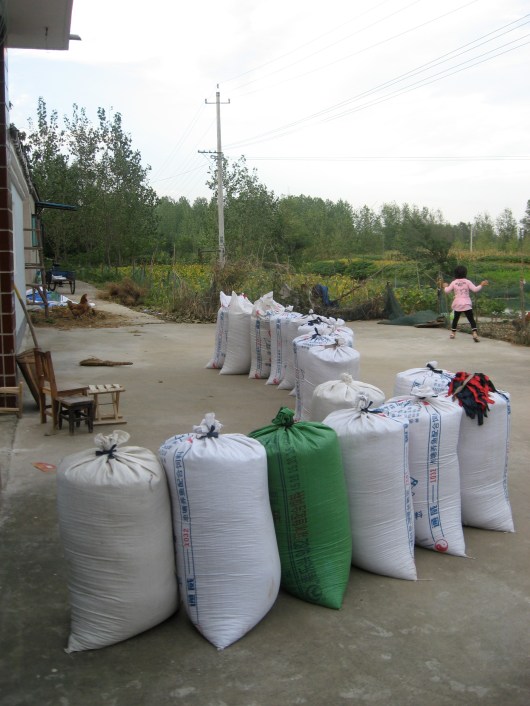
The rice, bagged and ready to sell.

The next morning we began by spreading the rice out again on the patio, for what would be the last time. Julie said they will sell 1/3rd of their rice the following morning, but that all the rice we had moved into the two barrels on the side of the patio will be theirs to eat over the next year.

That afternoon it was time to reap the rice patty. Julie said that her family had two patties large enough to be cut by machine, but one was quite small and would need to be cut by hand. I was excited on multiple fronts– after spending most of the past year in a classroom or library, I had not only come to romanticize the prospect of physical labor, but I also felt that getting ankle-deep into a rice patty would epitomize the disintegration of a curtain that I felt shrouded my image of China and I would finally see, at least a keyhole glimpse, the root of where rice comes from through the lives of people that produce it.
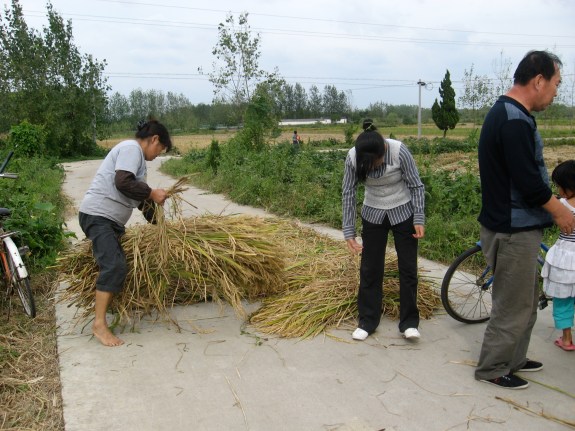
Julie's Mom, Dad, and cousin laying the rice out on the road to be flattened by passing cars.

Julie’s Mom, Dad, and cousin laying the rice out on the road to be flattened by passing cars.

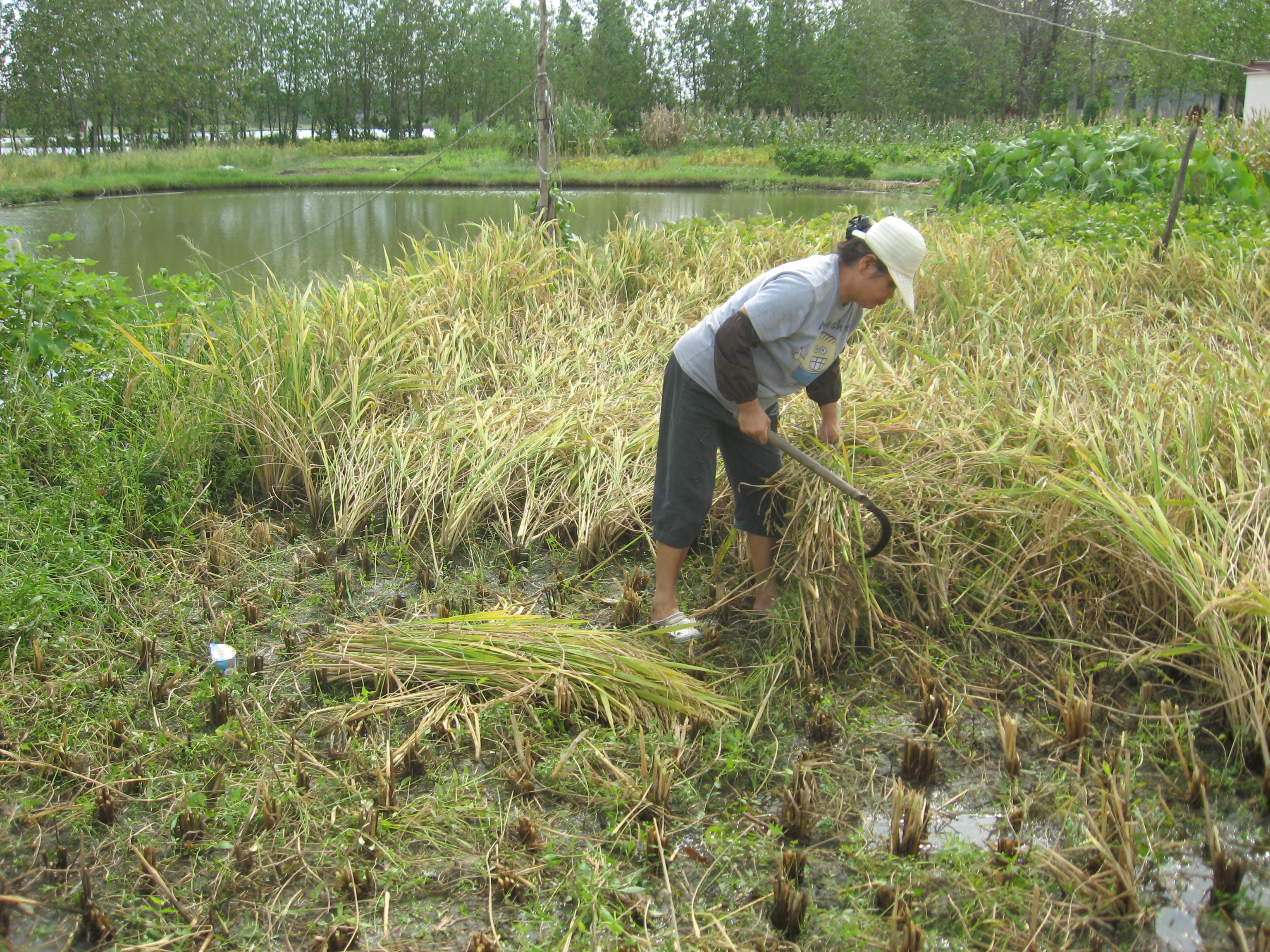
A small procession of family members and neighbors walked with us a few houses down and waited on the street while Julie, her mom, and I slid down the bank and mucked our way over to the plot that was easily decipherable through all the rice stalks that had already been cut around it. A hand-off system was devised where Julie’s mom began by cutting a bundle of stalks that I then carried over to the bank where Julie waited, and she then placed the stalks in the back of her father’s tricycle, where he drove them over to the main street where Julie’s cousin laid them out on the road for cars to flatten out by driving over them (it is only later that her family will lay them out on their cement patio to dry). The entire process didn’t last long, an hour at most, and was swiftly finished when a friend of Julie’s mom arrived to help finish cutting the stalks.

IMG_0649   IMG_0640

IMG_0665By this time it was evening and the sun was nearly setting. For dinner, Julie said we would first go catch fish at the local fish farm I had noticed when I first arrived. At her house we grabbed a fishing pole and pack of cigarettes as an offering to the fish-farm boss in exchange for allowing us to cast in his pond for the evening. Julie told me the fish-farm boss rents the fish farmland from the village collective, and he will often let villagers catch fish when they ask. So Julie, her father, cousin, neighbor and I all set off down the same path bordered by rice patties that we had taken for walks with Julie’s father.

IMG_0668

Julie’s neighbor fishing.

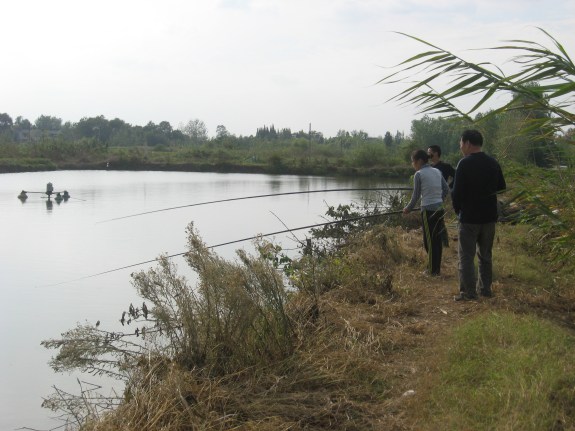
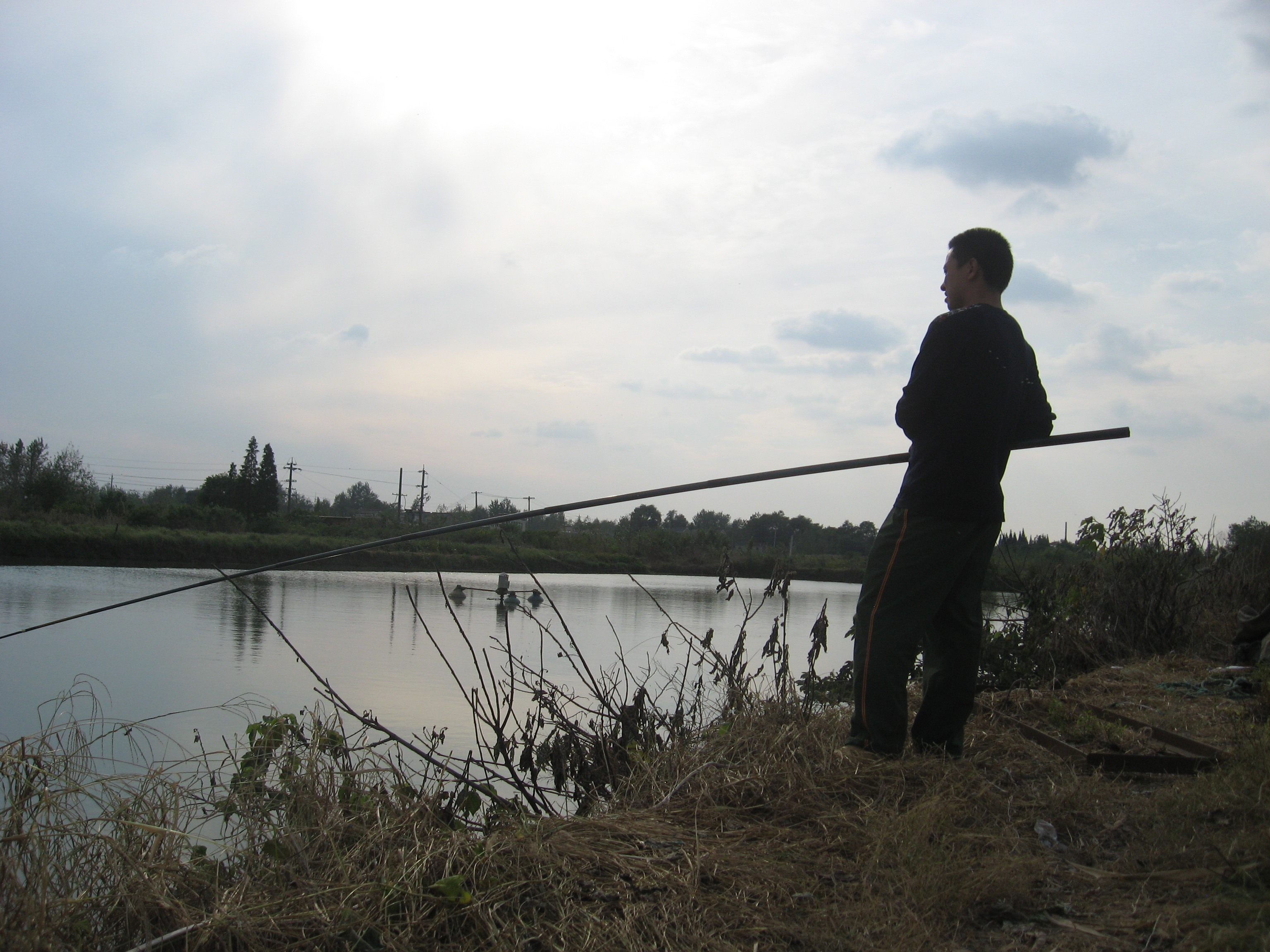
After a short exchange of pleasantries with the proprietor we assumed our positions at the edge of one pond, with Julie’s neighbor and dad taking the first casts. When twenty minutes had passed and only the neighbor had yielded a small fish the size of my hand (despite Julie’s cousin tossing in fish food alongside our rods) Julie’s father handed his reel off to me. Never having caught a fish before, I laughed nervously and threw the line out in the pond as far away from the bank as I could muster. Expecting my luck wouldn’t be much better, I fell into daydream mode, but was snapped back when Julie and her dad began shouting, “la! la!”.IMG_0670 I pulled the pole out of the water to find a fish slapping about at the end of my line. I hauled it up onto the bank where Julie’s cousin helped detach it from the hook and place it in a net we had submerged in the pond. I successfully repeated this process three times, before handing the rod back to Julie’s dad and joining her cousin who was busy weaving rings and headbands out of the tall grass at the edge of the bank. Our fishing expedition came to an end when Julie’s neighbor yelped in excitement as his rod strained under the weight of what was obviously a massive fish. He abruptly handed the rod off to Julie, removed his shocks and shoes, jumped into the pond, and plunged both hands under the water. After some grappling he managed to haul the fish out and toss it on the bank where it flopped about before it was secured inside the net with the rest of our catch. Satisfied with our success, we waved goodbye to the fish-farm boss, packed the tricycle with the rods and fish, and headed back to the house.

Check out the size of the fish on the left.

Check out the size of the fish on the left.

Julie’s cousin announced our return while displaying the neighbor’s catch for everyone to see. I do hate to play into the fish-size-myth stereotype, but this one was large enough justify a party. Julie’s mom immediately set about preparing it while the neighbor and his family, along with a variety of friends, sat outside with Julie’s father chatting casually. In expectation of a large group for dinner, Julie’s mom asked us to ride into town to buy some oil and beer. We set off, and Julie explained her family usually has enough oil for the year from her village’s harvest, but because harvest season was just ending they would need to purchase some from the local store before this year’s yield would be ready.

As we passed the elementary school Julie had attended, she explained that when she entered middle school she had to move away from home and live in the school’s dorms. She said this is often still the case– when families live too far to commute everyday the children must live at school. Now she has also heard of parents moving to the city to accommodate their kids and continue taking care of them. She even spoke of one woman she knew who quit her job to move to the city and now spends all day waiting on her son. In contrast, she credited her middle and high school boarding experience as having helped develop her independence.

We completed our task and rode back to the village where a group of ten or fifteen neighbors and friends were already gathered around the dining table that was set with the fish in the center and surrounded by various other dishes. Julie said that after her father became ill her neighbors and relatives would come by to ask how he was doing and if there was any help her mother needed; to show her appreciation her mother will often cook large dinners for their friends and family.

After we finished eating many of the guests stayed to chat. I sat quietly eavesdropping long enough to listen as their conversation meandered from worries about inflation to the exchange rate of the Yuan to the dollar. Julie and I soon retreated to her room to pack our things, and the following morning we set out early to catch our separate trains.
IMG_0677

Posted in 2010 Rural Field Visits | Tagged , , | 2 Comments

Liangzhu Village: I was the Ring Bearer in a Chinese Wedding

In sync with my habit of figuring things out as I go, I woke up early Tuesday morning to ‘baidu’ (China’s ‘google’ equivalent) the address of the farm I had made plans to visit in Liangzhu  (良渚) village. I had been in contact with the farm manager, Chen, for the past few weeks, and knew that I could get there by bus, but after studying the map I realized in just two hours I could make it there by Hangzhou’s bus line, and wouldn’t even need to go through one of the long-distance bus stations. Which also peaked my curiosity about what a farm would be like that was within such close proximity to the city’s urban core (just 15 kilometers from the city limits).

Liangzhu - bike and clock

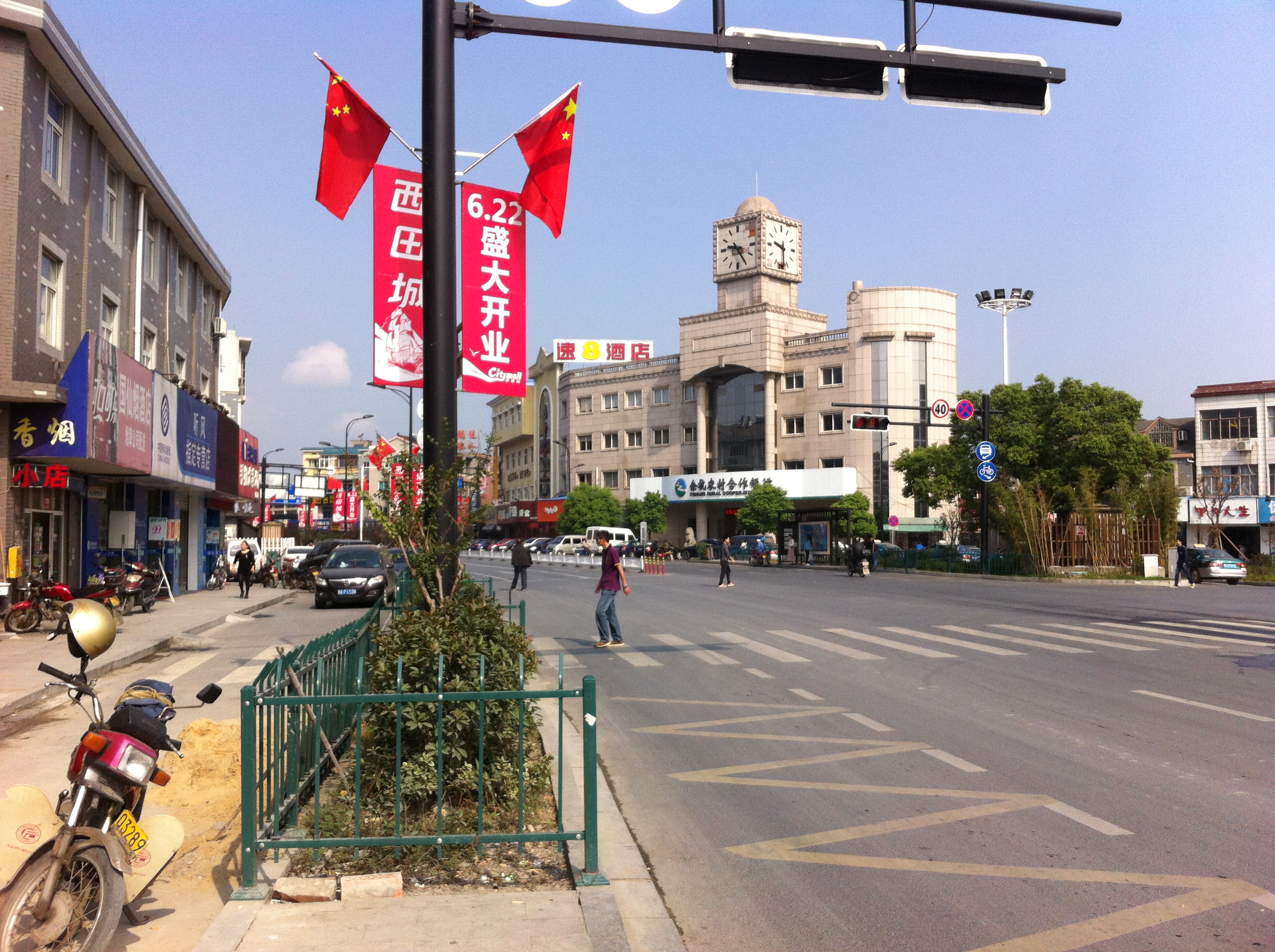
Liangzhu’s Main Street

About two and a half hours later I stepped off the bus in Liangzhu’s town square, and was almost immediately greeted by some curious locals anxious to help me find me way. I showed them the address, and some said it was close enough to walk while others said they didn’t know it, so I called Chen and he said he would be over in five minutes to pick me up. A cell phone shop across the street was blaring some old lady gaga song, competing for airwaves with whomever the House music aficionado was at the neighboring electric bike shop. Even though it was a tuesday afternoon, the streets were full because it was National Day, and the first day of a 7-day holiday.

Chen pulled up in a gray sedan, and I hopped in the passenger seat beside him. He said he would first show me his farm and the main office. About five minutes down the street we began passing fields of various vegetables, which he said were all his, along with pigs and ducks he raises. As we continued driving down the road he said that all of these fields are part of his farm, and that he rents the land from the other farmers in the village. I said I had learned that China has a policy where every rural citizen gets a plot of land from the government, and he said yes, but that he rents the land these farmers were allocated because they have found work in Hangzhou city.

Chen pulled into his farm’s parking lot, and gave me a quick tour through the rows of greenhouses which stretched as far as I could see before showing me the pig pen. He said that in China his farm is very big, but compared to the farms in the US it is tiny. I said yes, but that in the US these big farms are not so good because they produce a lot of waste, and he pointed at some tarp on the ground and said his farm produces waste too.

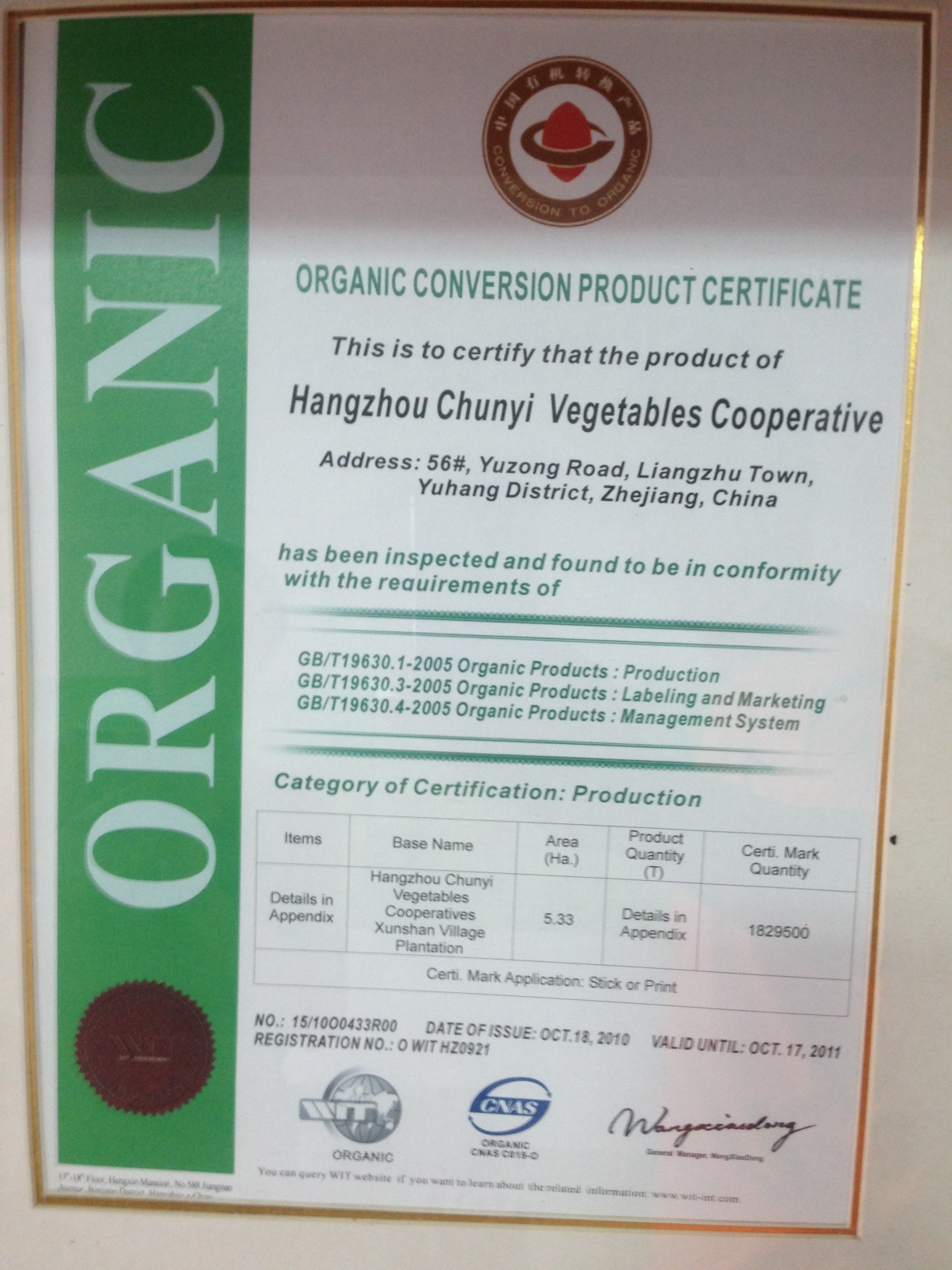
1001_1After taking a walk through some of the greenhouses we headed over to the office. He explained that there are eighty people that work on his farm , but because of the holiday they are all back with their families and will not be working this week. In the office he showed me through the lobby to a meeting room with two long furnished tables. All along one wall were bookshelves with plaques– each year they have won awards from the government, and there were even two plaques from the US, where they have now begun exporting crops. One was their organic certification by CNAS and WIT, China’s two organic certification agencies.

As we walked back to the car I said that even though people were on vacation this week I really wanted to work hard and would be willing to do whatever was needed, but he said it wouldn’t be necessary, that he just wanted me to see a new place and have fun. As we drove off he said that the day after tomorrow he was getting married, so he was going to be kind of busy. I couldn’t help but start to laugh in surprise and shock– how could he have been ok with me coming to visit the same week he was getting married– or at least failed to mention it? I thought there was no way and I just must have confused the word for ‘wedding’ with ‘celebration’ and he was just referring to some National Day celebration that was going on. I tried to ask what kind of special celebrations they have planned and how many people would be there, hoping his response would help clarify, but he just said more than a hundred people would be there. I decided it probably meant a celebration, but Chinese weddings can also be huge affairs, so I still really couldn’t really be sure.

After he helped me settle into my room he said he would be back at 6pm to bring me to his wife’s mother’s house for dinner. Which I thought definitely settled the wedding vs. celebration question.

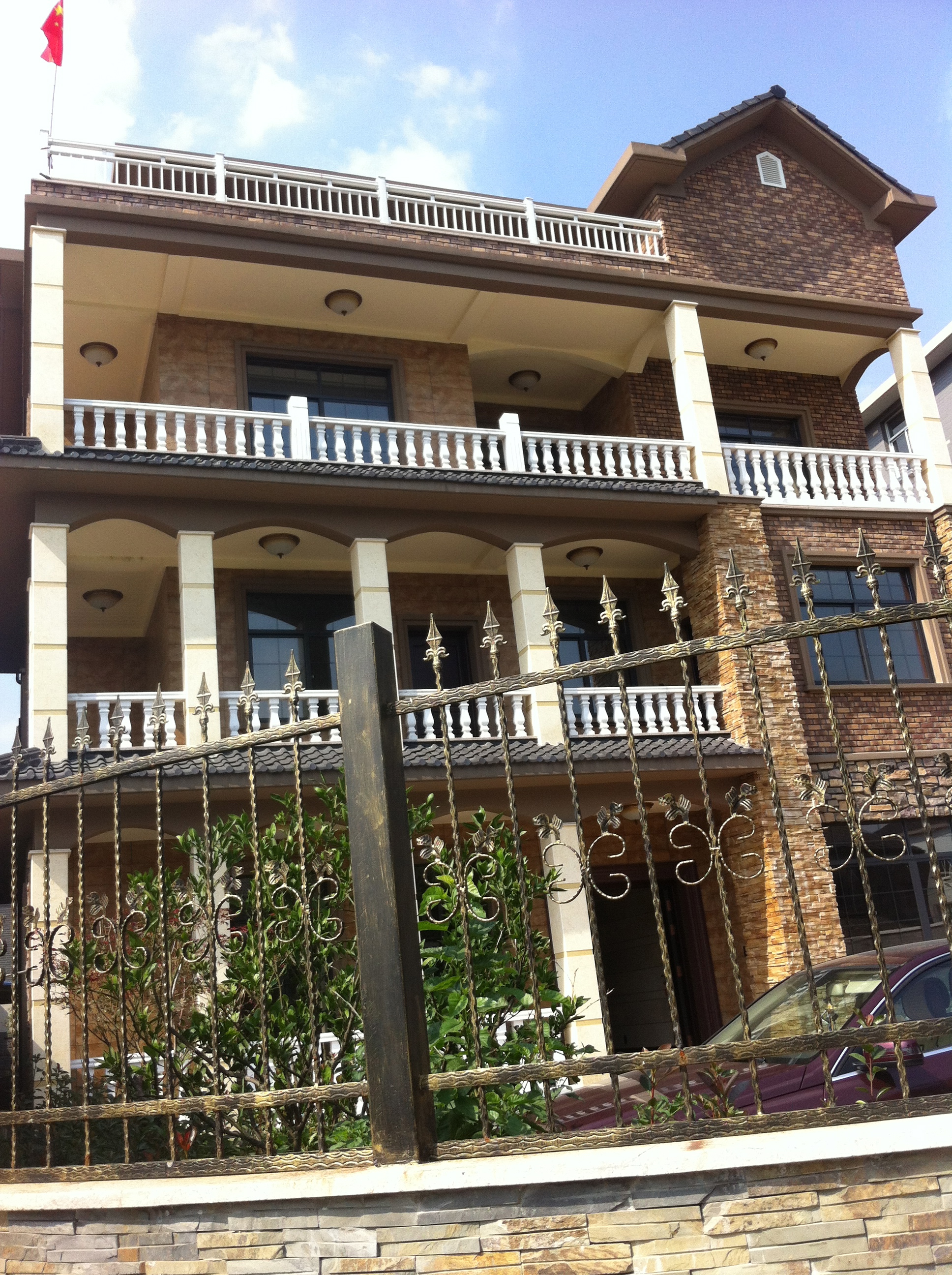
Bride's mother's home Front

This is Chen’s Mother-in-law’s new house. Just behind it is where her family currently lives. Eventually they will occupy both.

A few hours later we met downstairs and hopped back in the car, and after a quick ten minute drive to the outskirts of town we pulled up in front of a stone and cement 3-story house. It was by far the nicest house I have seen in any village in China. I later found out that a new home had just been constructed right in front of the old one. Chen’s wife’s home was similarly composed of two separate structures with a courtyard in the middle. I heard later that while these homes have four or five floors, everyone just uses the first and second floors and the other floors are extra rooms and for storing things. 

After entering through the front home (pictured above), we passed through a courtyard to the second home.

After entering through the front home (pictured above), we passed through a courtyard to the second home.

Chen’s wife’s mother was waiting out front, and they showed me inside to where dinner was already set out on the table. Chen introduced me to his wife and her sister, along with about five other men and another woman who were all related in some way or other. As Chen introduced his wife he said they were expecting a baby (I wouldn’t have been able to tell).

Chen and his wife had already eaten so they sat on the sofa adjacent to the table as the rest of us sat down to eat. Most of the men were chatting in Liangzhuhua, the local dialect, and I broke into the conversation now and then to ask if they all grew up in Liangzhu (yes) and if they all worked together on the farm (no). They asked me questions now and then about where I was from, and as they offered me food they said I didn’t need to worry about being so polite (when I’m nervous I have a habit of over-thanking to the point that it gets ridiculous).

I decided to visit a farm so close to the city because I knew it would most likely provide a counter-perspective to the glimpse of the more isolated villages I had intentionally sought out when I was here before. If you compare some of the photos from the homes of my previous field visits, you’ll see that it definitely did just that.

It was particularly interesting that Chen said he now rents most of the plots from other farmers in the village while they have found work in Hangzhou. I will briefly try to explain why (but if you’re just here for the story you can skip the next 5 paragraphs):

When I was here in 2010, the primary goal of my field research was to understand if rural farmers wanted to take advantage of a 2008 farmer-to-farmer land-transfer policy that was encouraging rural residents to integrate their collectively-allocated “noodle” plots and pursue full-time work in nearby towns or cities. The policy reveals the complexity of teh rural land-use issue in China because it’s three-pronged goals were ostensibly in the interest of farmers and the state: 1) to promote social mobility in the countryside; 2) to encourage productivity and more efficient grain production, and 3) to mitigate land conflicts with local officials by limiting their involvement in land transactions.

After the 1978 reforms, decollectivization resulted in every rural family receiving a plot of land through the collective. These plots, literally called “noodle plots” because they were often long strips of land, are insufficient to sustain a livelihood. Many rural residents are working as migrant laborers in cities and returning to their villages for the harvest season. This has led to all sorts of challenges: at the 50,000 ft. level, a lack of economies of scale and inefficient grain production, meanwhile on the family level, grandparents are left to look after their grandkids while the parents pursue opportunities, often risky and and informal labor like construction, street cleaning, and factory jobs, in town or cities

There were generally two contrasting academic perspectives regarding the land-transfer policy: the ‘optimists’ believed that limiting local officials’ involvement in land transfers while encouraging a redistribution of rural land would increase investment in agriculture, reduce the income gap between rural and urban workers, and stimulate domestic demand. The ‘pessimists’ believed the policy could lead to a monopoly of vast land resources in the hands of a small number of landlords and millions of landless farmers would lead to widespread urban slums and unemployment.

The conclusion of my 2010 thesis was that the land-transfer policy wasn’t going to work because farmers would rather hold onto their collectively-allocated farm plots as a basic source of security and subsistence rather than take the risk of transferring it to another farmer and permanently moving to nearby towns and cities where they might be left a landless peasant with only informal job opportunities.

This family contradicts my conclusion that farmers would prefer to pursue non-agricultural opportunities while holding onto their land as a source of subsistence and security. Not only are they successfully farming full-time, but other farmers in the village have made the decision to rent their land to this family and pursue full-time work in Hangzhou. The village’s proximity to the city obviously makes this a more viable option than for the families in the more isolated villages I visited before. For the families that rent their land to Chen and are working in Hangzhou, it would be interesting to find out whether they have been able to find formal or informal labor opportunities. It may speak to the country’s rising inequality, and reflect the pessimist’s view of the land-transfer policy– that it may lead to a monopoly of vast land resources in the hands of a small number of farmers– if Chen’s family has been able to do so well after acquiring so much land while other families are potentially pursuing insecure jobs in the city.

On the drive back that night I asked Chen how he had met his wife, and he said that they were at a stadium and he was playing football while she was running around the track. I said that I also liked to run, and he said that tomorrow afternoon he would take me to go running, but that the day after that would be his wedding (there was no mistaking this time) so he would be a little occupied. I tried to suppress my shock and asked what I could prepare to bring, and he said nothing, I just needed to bring my mouth and be ready to eat.

The morning of the wedding Chen’s friend knocked on my door to let me know it was time to leave, and along with a few other friends we all piled into a car and drove about 10 minutes over to Chen’s parent’s home.

IMG_0207

Chen and his wife.

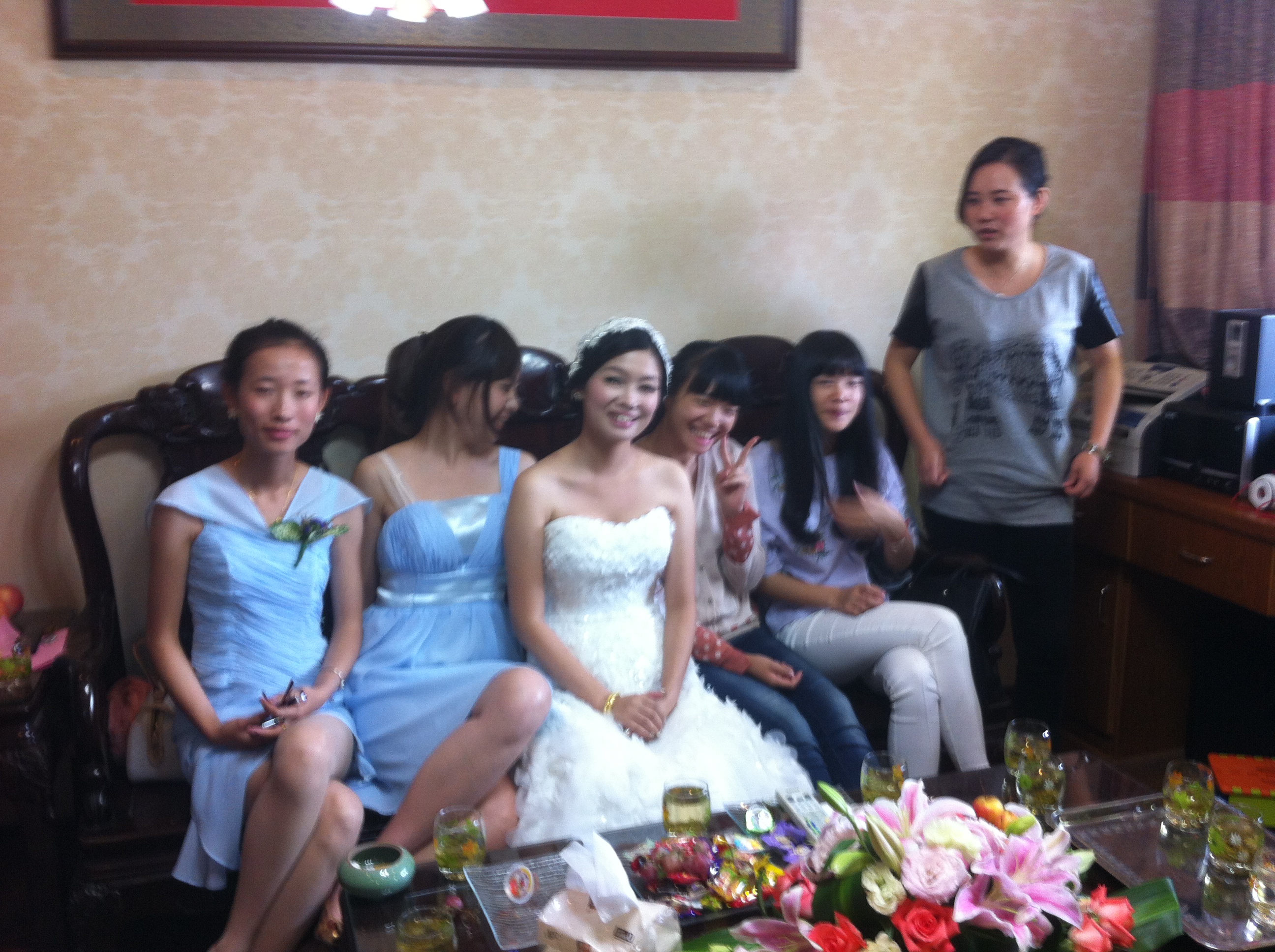
Various family members were mingling downstairs, but we all ascended three flights to where Chen’s best men were gathered watching a soccer game on television. I stood off to the side with the wife of one of Chen’s friend’s, and we made small talk until we heard fireworks going off outside that signaled the arrival of the bride and groom. Everyone gathered again out on the balcony, but soon began pouring outside into their various vehicles, and we all took off to a restaurant just a few minutes away. I rode with Chen’s friends, and after we had entered I hung back, unsure of where I should sit, but Chen caught my eye, led me up to the front of the room, and sat me at the table of his bride and her bridesmaids.

IMG_0198After lunch I followed his bride’s younger sister, Qiqi, back to the house where everyone was resting after what had obviously been a long morning getting ready. After an hour or so Chen called me into a separate room with one of his best men who could speak some English, and between the two of them they asked me if I would be the ring bearer in their wedding ceremony that night. I was honored and obviously accepted, but was also ridiculously nervous. I’ve been to a few Chinese weddings receptions (they can go on for days with meals first at the groom’s family’s home and then the bride’s), but have never seen an actual ceremony.

IMG_0233That night there were definitely more than a hundred people gathered in a private room of the same hotel where we had lunch. When the time came for the ceremony to start, Chen stood up on stage first, and waited for his bride to enter with her father. When they reached the edge of the platform runway, Chen walked out to meet them, kneeled down, made a speech and asked if she would be willing to be his wife. She said she was willing, took his arm, and together they walked the rest of the way down the runway. Then I walked down the runway with the rings on the stem of a rose. in hindsight, I walked way too quickly, but combined with being super nervous I’m just a naturally fast walker. Also, because I thought I was going to be spending the week on a farm, all I brought were my hiking boots.

IMG_0237        IMG_0235

After I gave them the rings, Chen’s dad came up and made a speech, then Chen made a speech, then his wife’s Dad made a speech, and then their parents all came up on stage and hugged each other. It was great.

IMG_0246IMG_0244

The ceremony was immediately followed by what we consider the reception. I’ll just say it was crazy:

IMG_0263

The following day Chen’s friend came and picked me up and drove me over to where everyone was now gathered at the bride’s home.

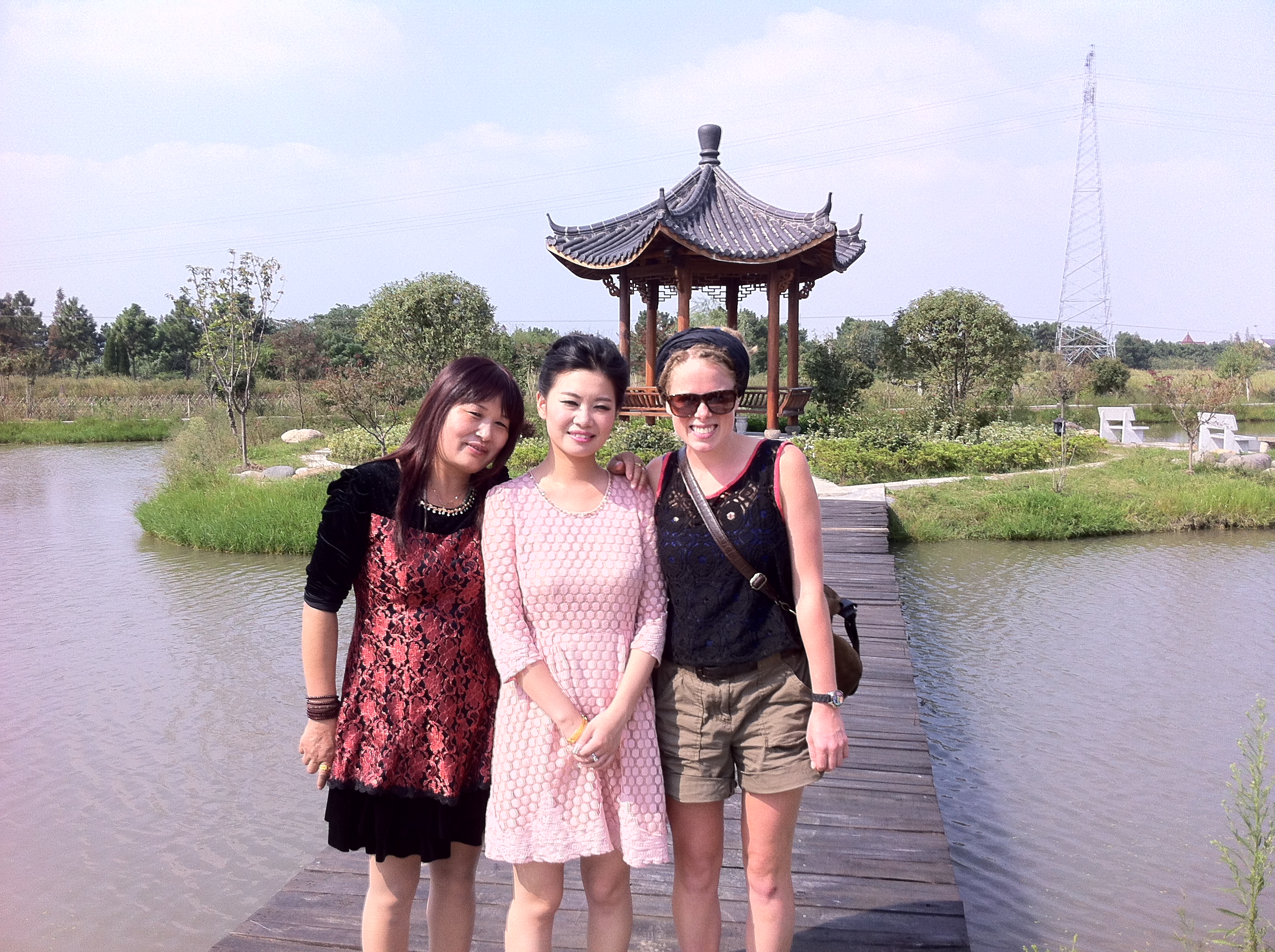
IMG_0289After lunch was finished I accompanied Chen’s wife, Qiqi, and a few friends just across the street to her mother’s house. We made our way out back to the garden that includes a gazebo and fish pond to go for a boat ride. Two of the other girls started off paddling, but soon we all began laughing as they readily confessed they did not know how. I offered to take over, even though I wasn’t much better.

Later that afternoon Chen, his wife, and a few of the best men and bridesmaids gathered in one of the extra rooms upstairs to gamble.

IMG_0322

IMG_0345After dinner that night, I thanked Chen and his family for so graciously welcoming me into their home. They welcomed me to come back, and we made plans to see each other again in the spring.

Chen’s friend who had brought me over in the morning drove me back to my room, and on the way we chatted (I had become much more talkative after being coerced into joining the best men and bridesmaids in drinking baijiu). After I explained that I was interested in China’s rural development, he said that the US has a better development system than China because in the US there is more technology. I replied that yes it is different, and in the US there is a lot of technology, but there are still a lot of people without jobs and right now our economy is not doing so well. He said that in China there is a lot of reliance on human labor, but that he thinks the system in the US is better.

After dropping me off that night I caught the bus back to Hangzhou early the next morning. It will be a few months before I have another break from classes to set out to my next field site, but in the meantime I’ll be adding periodic updates from the rest of my 2010 adventures.

Car - First or last photo

Posted in Zhejiang Province | Tagged , , , , , | 2 Comments

Shimen Village

For my first rural field visit this time around, my field advisor (and previous professor when I was here with the China Center), Liu Wei, offered me the opportunity to tag along with this year’s class of China Center students on their 1-day excursion to the village of ShiMen (石门村), situated about three hours through the mountains on bus from Hangzhou. As one of the richest provinces in China (#5 according to the Global Times), Zhejiang is the only one with a road that reaches every village.

After about two hours drive we began weaving around what is called “1,000 Islands Lake”, the largest man-made lake in China. While originally constructed as a  hydro-electric project, employment through the lake’s tourism now surpasses hydro-electric employment. During an interview later that afternoon we would hear more about the tumultuous history of the lake’s impact on the local population.

IMG_0055

That’s Mrs. Yu on the right.

Once we had made our way past the lake, our bus rendezvoused with a black sedan that Liu Wei explained contained our liaisons to the village: Mrs. Yu, a former student of his, who is now the head of the Communist Youth League at the county level, meaning she oversees the youth activities for about 200,000 people from ages 14-28. You can sort of imagine the Youth League as parallel to the Boy/Girl Scouts, but with a political undercurrent because Youth League membership means you have a better chance of Chinese Communist Party (CCP) membership. Her husband, Mr. Yu, is Vice Mayor of a neighboring township. Liu Wei said that they decided to introduce us to ShiMen village because 1) he told them he wanted them to show us a ‘regular village’ and not one of the ‘model villages’ that are often showcased to visitors because of new development or policies being implemented, and 2) this village serves as a ‘liaison’ between her office and the broader local population.

Upon arrival at ShiMen we were all properly introduced, and Liu Wei explained to Mr. Yu that I was his graduate student doing research on village-level implications of China’s rural land-use policies and development strategies. Mr. Yu said that prior to his current position as the township vice-mayor he also used to work in the financial department, so he knows a lot about village management. He invited me to come back for a week in November when a village within his township will be having local elections. As you can probably imagine I was thrilled and jumped at the opportunity.

Village Committee (VC) elections are super fascinating because they were first formed (in two Guanxi counties in late 1980-early 1981) without the knowledge of local officials. When word eventually reached Beijing, the vice-chairman of the  the National People’s Congress Standing Committee (NPCSC), Peng Zhen, praised them as “the perfect vehicle for practicing grassroots democracy.” Although local democratic elections probably seem counter-intuitive for an authoritarian government, Peng Zhen saw them as a tool necessary for tightening the Party’s rule in areas where its power was ambiguous. Despite heated debate, in 1987 a trial law was passed and the Ministry of Civil Affairs was entrusted with ensuring its implementation. While the elections are still subject to manipulation (VC members are elected from a slate of candidates that is decided by local officials), rural villagers have still recognized the elections as a tool to remove corrupt and incompetent cadres from power (rather than as a method to elect exactly who they want into power), and they have been vital to ensure proper local policy implementation. So they’re a fantastic example of how China’s policy development does not follow a strict top-down chain of command, but rural villagers have also initiated pivotal policy reforms.

On the left is Liu Wei, my field advisor, and Mr. Yu, the vice-mayor of a neighboring township.

On the left is Liu Wei, my field advisor, and Mr. Yu, the vice-mayor of a neighboring township.

After lunch that was served in the home of a local village council leader, we all gathered in a circle on the front cement patio to first hear Mr. Yu tell us about the area from the county-level perspective (Liu Wei helped translate):

The area has a long history – the county seat was established 1800 years ago. Because of poverty, the area is known for peasant uprisings, and more turmoil brings more poverty. The real turning point was in 1956 when the One Thousand Island reservoir was in construction. This demanded the removal of half of the county’s population: 300,000 people moved out to other regions and provinces, like the inland [and poorer] province Anhui, situated northwest of Zhejiang.

The whole county was reshaped and restricted because of the huge reservoir. This was a big state project to provide electricity. There was some compensation, but not enough, under this system the local population had no way to act, they had to obey.

Hangzhou as a prefecture, apart from the [6] urban districts, has five counties. This is the largest county in acreage because of terrain, and its inaccessibility. The road only reached every village very recently, this is the poorest [county] in economy.

IMG_0059

The county covers 4,427 square kilometers. It is very large, but arable land is limited: it is only 1/10th of this area, so people cannot live on agriculture. 70 percent is mountains while only 2 percent is water. Out of the 450,000 population, 100,000 are working as migrant laborers in Hangzhou and it’s surrounding towns to send cash back to their families.

The whole county has 23 townships and 425 villages. These are called ‘admin villages’. If you count natural villages it is 898, but some smaller villages come under the administration of one village council because you need a lot of people to form a council. The natural villages have been reduced by one-half. The largest town has a population of about 80-100,000 people, and 10-20,000 are a ‘floating’ population. The floating population is no longer illegal.

[China still has a ‘household registration system’, in place, where you are registered as either an urban or rural citizen. Urban migration used to be strictly regulated through rural citizens’ exclusion in cities from essential social services, but it is now much less so. Although it is still regulated in many areas as rural citizens must pay more for their children to enter school and healthcare.]

The backwardness of the economy was caused by the building of the dam– it blocked the traditional waterways leading to the sea… it put the economy of the county back by about 20-30 years. The construction was completed in 1959, but it was not until 1979 that the economy started to boom again. 20 years here were lost. It took 20 years to restore the economy at the level of 1959, and even today the economy hasn’t fully recovered because of environmental protections put in place. Pollution is not allowed, so it hinders local growth.

IMG_0088

A local woman picking tea.

Agriculture is still the main economy: tea, fruit, vegetables, and silkworm. It used to be forestry, but that has also been stopped because of protection of the water source for Shanghai and Hangzhou. Much of the development here is limited, but tourism has built up, along with the production of a popular brand of bottled water (Nongfu) and beer. But these can only produce so much. The population is growing, but the economy grows slowly. Forestry is a highly polluting industry, [and regulating it] is why we still have clean water, clean food, but this is also a sacrifice for the local populace.

The present [central] government is new, especially the prime minister, who has been advocating a policy of urbanization. The village people are mainly elderly, while the able-bodied are working in towns to earn money. According to local government policy, new areas of townships have been built to encourage people to move from remote areas for free: they get compensation for moving out of villages, with little cost added to living in small townships. We hope in a number of years those people who have not been able to benefit from development will be able to by living in these areas close to townships.

I later asked what is happening to the villages these people are leaving behind, and he said they are just abandoned. He also said the government has a policy to promote commercial farming and discourage private farming because of its low marketability.

[China’s post-1978 market reforms began with a policy that broke up collective land by allocating individual “noodle” plots to rural families. The government is now encouraging farmers to rent this land back to the government to integrate these “noodle” plots and create large-scale farms. There are essentially two contrasting perspectives regarding integration of these plots and encouraging farmers to move to more urban locations: the ‘optimists’ believe a redistribution of rural land will increase investment in agriculture, reduce the income gap between urban and rural workers, and stimulate domestic demand. The ‘pessimists’ believe it could lead to a monopoly of vast land resources in the hands of a small number of landlords and millions of landless farmers could lead to widespread urban slums and unemployment.]

IMG_0063

It was only older residents and a few small children that we saw in the village. There used to be a school in the village, but it closed a few years ago so the children have to board at the school in a neighboring town.

Furthermore, he continued, the “aging society” is a serious concern for governance of rural communities: there are hardly any young people around so the governing of village life has been weakened. Education is also weakened by lack of parental care. The grandparents will take care of the kids while the parents are away [working], so the family structure is changing in a negative way. The market drives the young labor force out of the village and into the township. This is a serious problem to tackle.

Moving on to the topic of the healthcare and pension system in the region, Mr. Yu said that both Beijing [the central government] and Hangzhou have been directing public financial resources into the healthcare and pension plans. Rural individuals pay in 100 Yuan/year [$16] while the government puts in 400 Yuan/year [$65], so in total they have 500 Yuan/year [$82] for healthcare. On average, this means 70 percent of their healthcare costs are covered by the project. This is a huge improvement over the last decade, but only in this region is this in place because it is one of the richest in the area.

[Liu Wei added that in other areas people pay in 25 Yuan and probably have less than 100 Yuan total available.]

The government also provides a 100 Yuan food subsidy for people over 60 years, so they can cover basic food costs, like 30 kilograms of rice, and they are encouraging families to start Bed and Breakfasts to attract tourism.

IMG_0084

That’s Mr. Yue in the middle, with Mr. Yu on the left and Liu Wei on the right.

Next, Mr. Yue, who is the head of the local Village Council (VC), introduced himself and gave us the village-level perspective (Liu Wei again translated). The village is governed by two councils – the Communist Party Branch, which has twenty Party advisors, and the VC, which he serves on. The VC is elected from a slate of candidates by the local residents; the slate is determined based on the size of the local population.  The Council members serve for three years, and all receive a small salary; the amount of their income depends on the number of villagers. If there are 500+ villagers, each member will receive 900 Yuan/month. Each Council member also has their own farm.

IMG_0075

Here’s a view of the village from the tea fields.

The village population is 6,978. Arable land is only 248 acres, and there are only three people for one acre of land, which is not much. There are 28,000 acres of forestry. 2/3rd of this are untouchable for protection of the water source, but 11,000 acres can be developed for bamboo, tea, fruit, and vegetables, and can sell these at the market in Hangzhou and Shanghai. In Hangzhou, per capita income is about $6,000 a year, while in the village people earn about $1,100 year, but they also grow most of their own food.

When asked what is most difficult about his job, and what he likes the most, Mr. Yue responded that arbitrating is the most difficult. When neighbors/family members have a problem, the city leadership is supposed to sort the problems out, but usually they are not welcome in the village. In regards to what he likes the most, he responded that every community needs leadership; it is satisfying that he can provide this service.

Mr. Yu added that the government provides financial aid to the local village, and the village leaders can access this aid and help direct resources where they are needed.

The alter to honor the 'land gods'.

The alter to honor the ‘land gods’.

After taking a tour around the village to meet some of the families and see the tea fields, we walked down the road to see where they have built something like an alter to honor the ‘land gods’. Liu Wei explained that while most of China is agnostic or atheist (proselytizing is actually illegal, and you must be an atheist to join the Communist Party), every village will have something like an alter to honor the land gods.

Ok that’s all for this week! This coming week is a holiday for China’s ‘National Day’, so I’ll be heading to a farm in Liangzhu not too far outside Hangzhou from October 1st to the 5th, more to come on that soon!

photoMe

Posted in Zhejiang Province | Tagged , , , | Leave a comment